


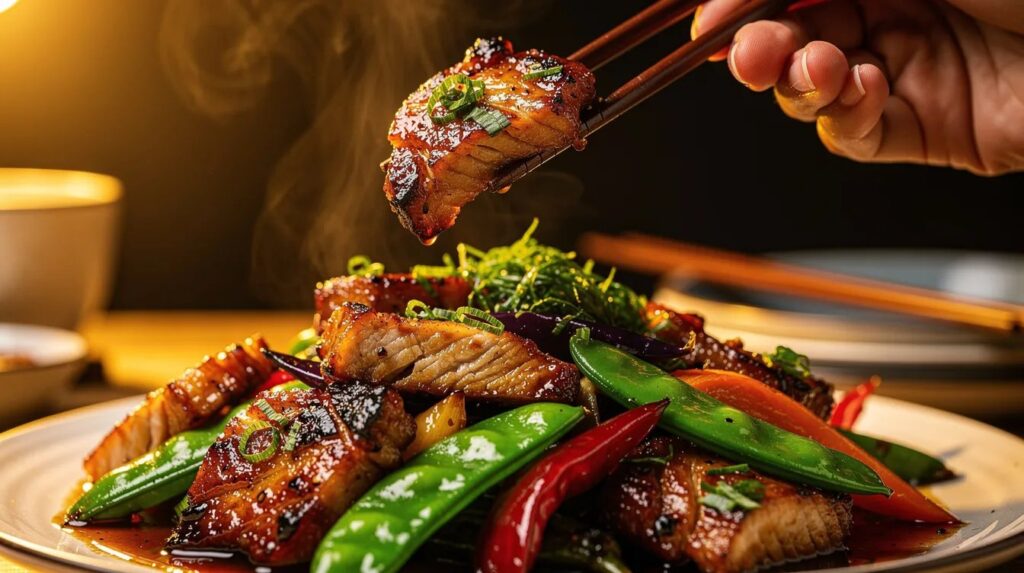
As spring edges into the UK's kitchen calendars this March, the evenings still carry a chill, making a sizzling wok the most natural thing in the world. Chinese pork stir-fry — the kind made with nothing more than good-quality pork, a handful of vegetables, and a sauce built from pantry staples — is one of those dishes that crosses every boundary: quick enough for a weekday, satisfying enough to silence a table of six. This version comes from a family kitchen where it has been cooked the same way for decades, adjusted only by instinct, never by recipe card.
What makes this particular stir-fry stand out is the layering of flavour that happens in a matter of minutes over very high heat. The pork is velveted — a classic Chinese technique that keeps the meat impossibly tender — and the sauce clings, glossy and aromatic, to every strip and floret. Once you understand the rhythm of the wok, you will not reach for a takeaway on a Tuesday night again. Apron on.
| Preparation | 20 min |
| Marinating | 20 min |
| Cooking | 12 min |
| Portions | 4 people |
| Difficulty | Medium |
| Cost | ££ |
| Season | Spring onions, tenderstem broccoli, fresh ginger |
Suitable for: Dairy-free · High in protein
Ingredients
For the pork and marinade
- 500 g pork loin or pork fillet, sliced thinly against the grain
- 1 tbsp cornflour
- 1 tbsp light soy sauce
- 1 tsp Shaoxing rice wine (or dry sherry)
- ½ tsp bicarbonate of soda
- 1 tsp sesame oil
- 1 tbsp neutral oil (groundnut or sunflower)
For the sauce
- 3 tbsp oyster sauce
- 2 tbsp light soy sauce
- 1 tbsp dark soy sauce
- 1 tsp sugar (caster or granulated)
- 1 tsp cornflour dissolved in 3 tbsp cold water
- 1 tsp sesame oil
For the stir-fry
- 3 tbsp neutral oil
- 4 cloves garlic, finely sliced
- 30 g fresh ginger, peeled and cut into fine matchsticks
- 1 red pepper, deseeded and sliced into strips
- 200 g tenderstem broccoli, halved lengthways
- 4 spring onions, cut into 4 cm lengths
- 1 tsp dried chilli flakes (optional)
Utensils
- Large wok or wide, deep frying pan
- Sharp chef's knife and chopping board
- Two mixing bowls (one for marinade, one for sauce)
- Small whisk or fork
- Wok spatula or large wooden spoon
- Kitchen tongs
- Colander
Preparation
1. Slice and velvet the pork
Place the pork in the freezer for 15 minutes before slicing — firm meat is far easier to cut into the thin, uniform strips that cook evenly in a hot wok. Slice across the grain into pieces no thicker than 5 mm; cutting against the grain shortens the muscle fibres and produces a noticeably more tender result on the plate. Transfer the strips to a bowl and add the cornflour, light soy sauce, Shaoxing rice wine, bicarbonate of soda, sesame oil, and neutral oil. Mix well with your hands until every piece is evenly coated. The bicarbonate of soda is the key to velveting — a technique borrowed from professional Chinese kitchens whereby a small amount of alkali raises the pH of the meat's surface, preventing protein fibres from seizing up over high heat. The result is pork that stays silky where it would otherwise turn rubbery. Leave to marinate at room temperature for 20 minutes, no longer, or the texture can become slightly spongy.
2. Mix the sauce
While the pork marinates, combine the oyster sauce, light soy sauce, dark soy sauce, and sugar in a small bowl and stir until the sugar dissolves. The dark soy contributes both colour and a gentle, almost molasses-like depth, while the oyster sauce provides the savoury, slightly sweet body that clings beautifully to the meat. In a separate cup, mix the cornflour with cold water until completely smooth — this slurry will be added at the very end of cooking to thicken the sauce to a lacquered, glossy consistency. Add the sesame oil and set everything aside within arm's reach of the hob; once the wok is hot, there is no time to search for bottles.
3. Blanch the tenderstem broccoli
Bring a small pan of water to a rolling boil and drop in the tenderstem broccoli for exactly 90 seconds. Drain immediately through a colander and run under cold water to halt the cooking. This brief blanching means the broccoli enters the wok already part-cooked, so it needs only seconds of stir-frying to turn bright, vivid green with a pleasant bite. Using broccoli straight from raw risks either undercooking it or overcrowding the wok with excess moisture, which would cause the pork to steam rather than sear.
4. Sear the pork over maximum heat
Set the wok over the highest flame your hob can produce and leave it for a full 2 minutes until it begins to smoke lightly. Add 2 tablespoons of neutral oil and swirl to coat. Add the marinated pork in a single layer — resist the urge to stir immediately. Leave untouched for 45 to 60 seconds, allowing the meat to develop a pale golden crust on the underside before turning. You should hear an aggressive sizzle the moment the pork makes contact with the pan; if the sound is a timid hiss, the wok is not hot enough. Work in two batches if necessary to avoid lowering the temperature. Once the pork is just cooked through — opaque throughout but still yielding — remove it from the wok and set aside on a plate.
5. Build the aromatics
Wipe the wok clean with a folded piece of kitchen paper held with tongs, then return it to the heat with the remaining tablespoon of oil. Add the sliced garlic and ginger matchsticks together and stir constantly for 20 to 30 seconds. The goal is to soften and perfume the oil without colouring the garlic, which turns bitter within seconds if left unattended. Add the chilli flakes now if using — their heat blooms in fat far more effectively than it does in liquid. Follow immediately with the red pepper strips and stir-fry for 2 minutes, keeping everything in constant motion.
6. Bring it all together
Return the seared pork to the wok along with the blanched tenderstem broccoli and the spring onion lengths. Pour the sauce over the contents of the wok and toss vigorously for 1 minute, coating every piece in the dark, aromatic liquid. Give the cornflour slurry a final stir — the starch settles quickly — and pour it into the wok in a thin stream while tossing continuously. Within 30 to 40 seconds, the sauce will transform: it thickens, turns glossy and translucent, and clings tightly to the pork and vegetables rather than pooling at the bottom of the wok. Remove from the heat immediately and transfer to a warm serving dish.
My chef's tip
The single factor that separates a flat stir-fry from a genuinely memorable one is the temperature of the wok. Domestic hobs lack the raw power of restaurant burners, but you can compensate: heat the wok bone-dry for two full minutes before adding oil, cook in smaller batches, and never add cold ingredients directly from the refrigerator. In early spring, tenderstem broccoli is at its best — slender, sweet, and quick to cook. Should you find it unavailable, purple sprouting broccoli from a British grower works beautifully at this time of year and needs no more than the same 90-second blanch. For a deeper, nuttier finish, replace half the neutral oil in step four with a small amount of toasted sesame oil added only off the heat.
Wine and drink pairings
The sauce in this stir-fry is built on deep umami, a gentle sweetness from the oyster sauce, and a quiet heat from ginger and chilli — a profile that calls for wines with aromatic lift, low tannins, and enough acidity to cut through the savoury glaze without overpowering the delicate pork.
An off-dry Alsatian Riesling or a Gewurztraminer from the same region brings floral, spiced notes that mirror the ginger beautifully, while its natural sweetness balances the saltiness of the soy. A light, chilled Beaujolais-Villages — served slightly cool at around 14°C — offers enough red fruit brightness to complement the pork without clashing with the sauce. For a non-alcoholic option, a sparkling white grape juice with a wedge of fresh lime or a lightly sweetened jasmine green tea served chilled both hold their own against the dish's bold flavours.
About this dish
Pork stir-fry in one form or another appears across nearly every regional cuisine in China, from the smoky, fermented black bean preparations of Cantonese cooking to the fiercer, chilli-laden versions of Sichuan and Hunan. What unites them is the technique: intense heat, speed, and the careful orchestration of ingredients added in a precise order so that nothing overcooks and nothing undercooks. The dish arrived in British homes through the waves of Chinese immigration in the twentieth century, adapted over generations to local larders — lighter on the dried spices, heavier on fresh aromatics — without losing any of its essential character.
The family version presented here sits firmly in the Cantonese tradition: sauce-forward, balanced, and built for a communal table. It is the kind of recipe that is rarely written down, passed instead through proximity and repetition, adjusted by the cook's hand rather than a measuring spoon. Served alongside steamed jasmine rice, it feeds a family of four generously, and the leftovers — eaten cold, straight from the container the following morning — are quietly argued to be even better.
Nutritional values (per portion, approximate values)
| Nutrient | Amount |
|---|---|
| Calories | ~390 kcal |
| Protein | ~36 g |
| Carbohydrates | ~18 g |
| of which sugars | ~7 g |
| Fat | ~19 g |
| Fibre | ~3 g |
Frequently asked questions
Can this dish be prepared ahead of time?
The pork can be sliced, marinated, and refrigerated for up to 4 hours before cooking, which makes it an excellent option when preparing a larger meal. The sauce can also be mixed and stored in a jar at room temperature for the same period. However, the stir-fry itself should always be cooked to order — it takes under 15 minutes and its textures are at their best in the first few minutes after leaving the wok.
How should leftovers be stored?
Cool the stir-fry to room temperature within an hour of cooking, then transfer to an airtight container and refrigerate for up to 2 days. Reheat in a hot wok or frying pan with a small splash of water to loosen the sauce, rather than in a microwave, which tends to toughen the pork. Do not freeze — the cornflour-thickened sauce breaks on thawing and the pork loses its texture entirely.
What substitutions work well in this recipe?
Pork fillet can be replaced with chicken thighfirm tofu pressed and patted dry — the same velveting marinade applies to both, though tofu does not require bicarbonate of soda. Shaoxing rice wine can be swapped for dry sherry or even a splash of dry white wine without a noticeable loss of flavour. In spring, sugar snap peas or thin asparagus spears — both arriving in British markets from March onwards — work beautifully in place of, or alongside, the tenderstem broccoli.
Is it possible to make this gluten-free?
Yes, with a few straightforward swaps. Replace both the light and dark soy sauces with tamari, which is brewed without wheat and widely available in UK supermarkets. Check the label on your oyster sauce — several brands produce certified gluten-free versions. Cornflour is naturally gluten-free, so the marinade and slurry require no adjustment.
What is the best cut of pork for a stir-fry?
Pork loin and pork fillet are the two most practical choices: both are lean enough to cook quickly and tender enough to remain pleasant after high-heat searing. Avoid shoulder for this application — its higher fat and connective tissue content suits slow cooking rather than the rapid, intense heat of a wok. If only pork chops are available, simply remove the bone and any thick fat border before slicing.