
March arrives with that particular chill still clinging to British mornings, and the urge to bake something substantial — something that fills the kitchen with warmth before the oven has even reached temperature — becomes almost impossible to resist. Soda bread has fed these islands for centuries, requiring neither yeast nor patience, just a firm hand and a hot oven. This version takes that humble loaf somewhere altogether more satisfying: stuffed with seasoned mashed potato, served alongside a slow-cooked shepherd's gravy thick with lamb, root vegetables, and the faint sweetness of early spring leeks.
What makes this recipe stand apart is the marriage of two great British comfort traditions — the Irish soda loaf and the shepherd's pie filling — reimagined as a centrepiece you can bring to the table in under two hours. The bread tears open to reveal a creamy, herb-flecked potato heart, and the gravy — dark, glossy, deeply savoury — pools into every crevice. It is not a delicate dish. It is the kind of thing that makes people go quiet at the table. Tie your apron and get the oven on.
| Preparation | 35 min |
| Cooking | 55 min |
| Portions | 6 people |
| Difficulty | Medium |
| Cost | ££ |
| Season | Spring leeks, floury potatoes, lamb mince |
Ingredients
For the soda bread
- 450g plain flour, plus extra for dusting
- 1 tsp bicarbonate of soda
- 1 tsp fine sea salt
- 1 tsp caster sugar
- 350ml buttermilk, cold
- 1 tbsp unsalted butter, melted, for brushing
For the potato stuffing
- 500g floury potatoes (such as Maris Piper or King Edward), peeled and quartered
- 40g unsalted butter
- 3 tbsp whole milk
- 2 tbsp fresh chives, finely chopped
- 1 tbsp fresh flat-leaf parsley, finely chopped
- Salt and freshly ground black pepper
For the shepherd's gravy
- 400g lamb mince, ideally 20% fat
- 1 medium onion, finely diced
- 1 large leek, trimmed, halved and sliced (spring leeks preferred)
- 2 carrots, peeled and finely diced
- 2 cloves garlic, minced
- 2 tbsp tomato purée
- 1 tbsp plain flour
- 200ml lamb or beef stock
- 150ml red wine (or additional stock)
- 2 sprigs fresh rosemary
- 1 sprig fresh thyme
- 1 tbsp Worcestershire sauce
- Salt and freshly ground black pepper
- 1 tbsp neutral oil (sunflower or vegetable)
Utensils
- Large mixing bowl
- Medium saucepan (for potatoes)
- Potato ricer or masher
- Large heavy-based frying pan or sauté pan (for the gravy)
- Baking tray lined with baking parchment
- Sharp knife and chopping board
- Pastry brush
- Wooden spoon
- Measuring jug
Preparation
1. Cook and season the potato stuffing
Start with the potato stuffing, as it needs time to cool before it can be handled comfortably. Place the peeled, quartered potatoes in a medium saucepan, cover with cold salted water, and bring to the boil over a high heat. Reduce to a steady simmer and cook for 18 to 20 minutes, until a knife passes through the flesh without any resistance. Drain thoroughly — and this step matters — return the potatoes to the warm pan and shake briefly over the lowest possible heat to drive off any residual steam. Excess moisture is the enemy of a well-structured stuffing: wet potato will make the bread soggy from within. Pass the potatoes through a ricer (a drum-shaped tool that extrudes cooked potato in fine threads, producing an exceptionally smooth mash) or mash vigorously with a traditional masher. Beat in the butter and milk until the mixture is smooth and holds its shape. Fold in the chives and parsley, season generously with salt and pepper, then set aside to cool to room temperature. The stuffing should be firm enough to shape into a rough disc.
2. Build the shepherd's gravy
Pour the oil into the large frying pan and set it over a high heat until it shimmers. Add the lamb mince in a single layer without stirring — resist the urge to move it immediately. Allow it to sear, developing a deep brown crust on the underside before breaking it apart, about 3 to 4 minutes. That caramelisation is where the gravy's depth of flavour originates. Reduce the heat to medium, add the diced onion and carrot, and cook, stirring occasionally, for 6 to 7 minutes until softened and beginning to colour at the edges. Add the leek and garlic and cook for a further 3 minutes, until the leek is translucent and tender — spring leeks are noticeably sweeter and less fibrous than their winter counterparts, so they melt beautifully into the sauce. Push everything to the edges of the pan, add the tomato purée to the centre and let it cook directly against the hot pan for 1 to 2 minutes, stirring constantly, until it deepens in colour and loses its raw sharpness. Stir in the flour and coat everything well. Pour in the red wine, scraping the bottom of the pan with the wooden spoon to lift any browned bits — these are known as fond, the concentrated residue that forms the backbone of any good sauce. Add the stock, Worcestershire sauce, rosemary, and thyme. Bring to the boil, then reduce to a gentle simmer, partially covered, for 25 to 30 minutes, until the gravy is glossy and coats the back of a spoon. Remove the herb sprigs, taste, and adjust seasoning. Keep warm on the lowest heat.
3. Make the soda bread dough
Preheat the oven to 220°C / 200°C fan / Gas Mark 7. In the large mixing bowl, combine the flour, bicarbonate of soda, salt, and sugar, and whisk briefly to distribute evenly. Make a well in the centre and pour in the cold buttermilk. Using one hand or a round-bladed knife, bring the dough together with swift, light movements — overmixing activates the gluten and results in a dense, tough loaf rather than the characteristic open crumb of good soda bread. Stop as soon as the dough just comes together into a shaggy, slightly sticky mass. Turn it out onto a lightly floured surface.
4. Stuff and shape the loaf
This is the most tactile stage of the recipe, and it rewards a confident hand. Gently flatten the dough into a rough oval shape, approximately 28 cm long and 2 cm thick, without stretching or tearing it. Spoon the cooled potato stuffing onto one half of the oval, leaving a 2 cm border all around the edge. Shape the filling into a flat, even layer — if it is piled too high in the centre, the bread will crack open unevenly during baking. Fold the unloaded half of the dough over the filling, as you would close a book, and press the edges together firmly to seal. Mould it gently into a round, domed loaf. Transfer to the lined baking tray, seam-side down. Using a sharp knife, cut a deep cross — a traditional farl cross — through the top of the loaf, cutting almost but not quite all the way through. This allows the heat to penetrate the centre and prevents the crust from cracking haphazardly. Dust the surface lightly with flour and brush the edges with the melted butter.
5. Bake the loaf
Slide the tray into the centre of the hot oven and bake at 220°C for 15 minutes. Without opening the oven door, reduce the temperature to 190°C / 170°C fan / Gas Mark 5 and continue baking for a further 25 to 30 minutes. The loaf is ready when it is deep golden brown on top and sounds hollow when tapped firmly on the base — this hollow resonance is the reliable sign that the crumb structure is fully set. If the crust is colouring too quickly, lay a loose sheet of foil over the top for the final 10 minutes. Transfer to a wire rack and allow to rest for at least 10 minutes before slicing; cutting too early causes the potato interior to collapse and steam escapes before the crumb has set properly.
6. Serve
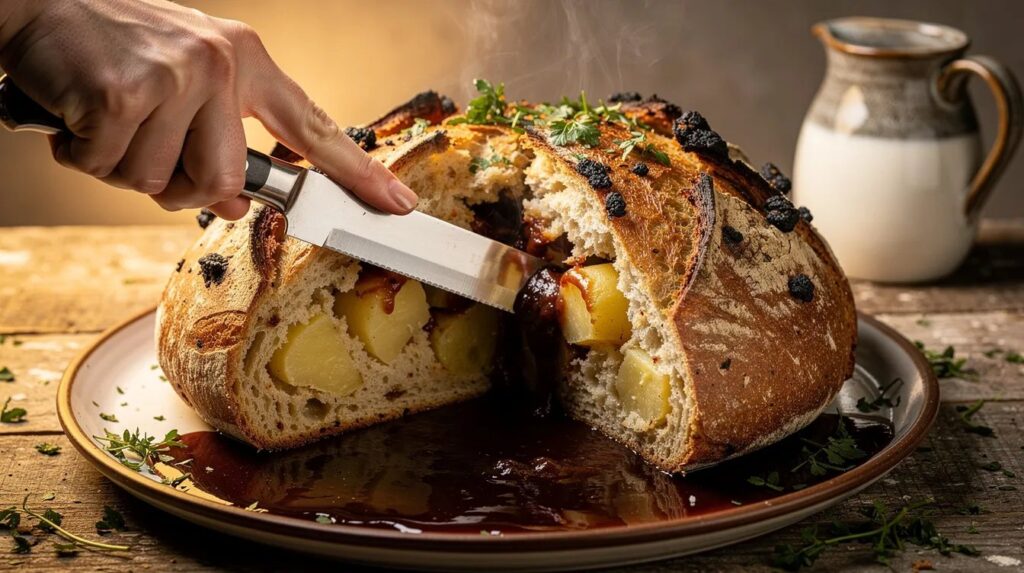
Slice the loaf into thick wedges at the table. Ladle the shepherd's gravy generously into a warmed jug or pour directly over the portions. The cross-section should reveal a distinct layer of pale, herb-speckled potato encased in that characteristically coarse, slightly tangy crumb. Serve immediately, with the remaining gravy alongside.
Chef's tip
The single step that most cooks skip is drying the mashed potato thoroughly before using it as a stuffing. After draining the potatoes, return them to the hot pan off the heat for a full two minutes, shaking occasionally — you will see a faint steam rising. This removes the surface moisture that would otherwise create pockets of sogginess within the baked loaf. In spring, a small handful of finely chopped wild garlic — Allium ursinum, which appears in woodland and hedgerows across Britain from late March — folded into the mash in place of chives elevates the stuffing considerably and gives the whole dish a seasonal precision that dried herbs simply cannot replicate.
Food and drink pairings
The shepherd's gravy has a savoury depth anchored by lamb fat, rosemary, and red wine reduction — the ideal pairing leans towards medium-bodied reds with earthy, rustic character rather than fruit-forward styles that would clash with the mineral tang of the soda bread.
A Côtes du Rhône based on Grenache and Syrah brings the right combination of dark fruit, pepper, and garrigue — the wild herbs of southern France that echo rosemary on the palate. A Malbec from Argentina, slightly less tannic, offers an accessible alternative with good grip. For those avoiding alcohol, a dark, unsweetened elderberry cordial diluted with sparkling water mirrors the gravy's depth without competing with the lamb. A robust pot of builders' tea, brewed strong and served without milk, is the most classically British option of all.
About this dish
Soda bread belongs to the fabric of Irish culinary identity, its origins tied to the mid-nineteenth century when bicarbonate of soda became widely available and provided a fast leavening alternative to yeast — crucial in a time when resources were scarce and ovens unreliable. The use of buttermilk, a by-product of butter-making, was both economical and chemically deliberate: the lactic acid reacts with the bicarbonate to produce carbon dioxide, creating the lift that gives the loaf its texture. Traditional soda bread was baked in a bastible, a cast-iron pot suspended over the fire, and the cross cut into the top was said to let the devil out — though the practical purpose of enabling even heat penetration was just as significant.
The shepherd's gravy draws on an older British tradition still: shepherd's pie, a dish recorded in cookery books from the late nineteenth century, designed to make use of leftover roast lamb. The term "shepherd's" specifically denotes lamb or mutton — as opposed to "cottage pie," which uses beef. This recipe does not treat the gravy as a vehicle for leftovers but builds it from scratch, allowing the flavours of early spring vegetables — particularly the season's leeks — to carry through. The combination of stuffed bread and a poured sauce has parallels in several Northern European traditions, from the stuffed dumplings of Eastern Europe to the bread-based soups of medieval British kitchens. It's simply very good food, made well.
Nutritional values (per serving, approximate values)
| Nutrient | Amount |
|---|---|
| Calories | ~620 kcal |
| Protein | ~28 g |
| Carbohydrates | ~72 g |
| of which sugars | ~6 g |
| Fat | ~22 g |
| Fibre | ~5 g |
Frequently asked questions
Can this be prepared in advance?
The shepherd's gravy improves significantly when made a day ahead — the flavours deepen overnight, and the fat that rises to the surface can be skimmed off easily once chilled. Reheat gently over a low flame, adding a splash of stock if the consistency has thickened too much. However, the soda bread is best baked on the day of serving, as it stales quickly and the potato stuffing can make the crumb turn dense if refrigerated and reheated.
How should leftovers be stored?
Wrap any remaining soda bread tightly in a clean tea towel and store at room temperature for up to 24 hours. Beyond that, the bread dries out noticeably. Slices can be toasted from room temperature and served with leftover gravy, which keeps refrigerated in an airtight container for up to 3 days or frozen for up to 2 months. Reheat the gravy slowly over a low heat, stirring regularly to prevent the base catching.
What substitutions are possible?
If buttermilk is unavailable, combine 330ml whole milk with 2 tablespoons of lemon juice or white wine vinegar, stir once, and leave for 5 minutes — the milk will curdle slightly and behave almost identically to buttermilk in the dough. For the gravy, beef mince can replace lamb for a more budget-conscious version, though it produces a less aromatic, more neutral sauce. In spring, wild garlic leaves or young spinach stirred into the potato stuffing make a seasonal and flavourful variation. The red wine in the gravy can be replaced entirely with additional stock for a more family-friendly result.
Why does the bread crack open at the sides rather than along the cross?
This usually means either the cross was not cut deeply enough — it should go at least halfway through the depth of the loaf — or the dough was overworked before shaping, creating too tight a surface tension. The cross is not merely decorative: it directs the oven spring along a controlled path. If the cuts are too shallow, the gas created by the chemical reaction finds another route out, splitting the sides instead. A firm, deliberate cut with a sharp knife before the loaf goes into the oven resolves this entirely.
Can this be made without meat?
The potato stuffing is naturally vegetarian and requires no modification. For a vegetarian gravy that retains comparable body and depth, replace the lamb mince with 250g cooked green lentils and 200g finely diced mushrooms — chestnut or portobello work particularly well — and use a good vegetable stock in place of lamb or beef stock. The Worcestershire sauce should be swapped for a vegetarian alternative, as the original contains anchovies. The result is a darker, earthier gravy that has its own distinct character.