


As March settles in and the last of winter's chill lingers over British kitchens, the temptation to reach for something warm, simple and deeply satisfying is hard to resist. Cabbage rarely gets the spotlight it deserves — too often dismissed as a humble, slightly watery afterthought — yet in Tuscany, slow-cooked greens have long been treated as something far more considered. This recipe borrows that philosophy entirely: generous heat, good olive oil, and enough patience to coax something extraordinary from a vegetable that costs almost nothing at the market.
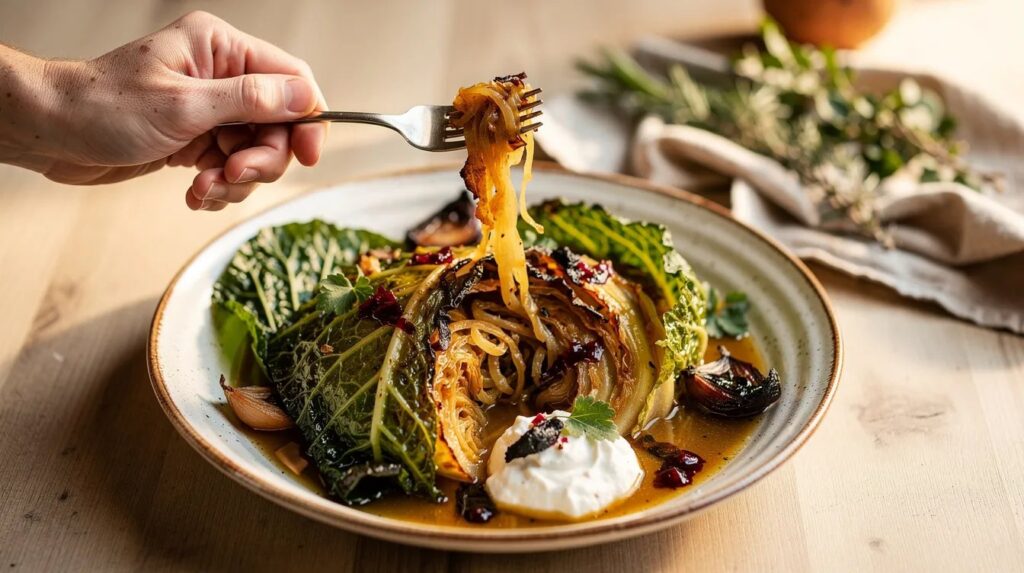
What makes this particular preparation stand out is the technique. The cabbage is not steamed, not boiled, not stir-fried — it is slowly collapsed in a wide pan until its leaves turn silken, its natural sugars begin to caramelise at the edges, and the whole thing takes on a colour somewhere between pale gold and deep amber. The result is tender without being soft, rich without being heavy, and carries just enough bitterness to balance everything else on the plate. Spring Primo cabbage or Savoy from a trusted greengrocer will serve you well right now. Tie on your apron.
| Preparation | 10 min |
| Cooking | 35 min |
| Portions | 4 people (as a side dish) |
| Difficulty | Easy |
| Cost | £ |
| Season | Savoy cabbage, Primo cabbage, spring garlic |
Suitable for: Vegan · Vegetarian · Gluten-free · Dairy-free
Ingredients
- 1 medium Savoy or Primo cabbage (~900 g), outer leaves removed
- 5 tbsp extra-virgin olive oil, good quality
- 4 cloves of garlic, thinly sliced
- 1 tsp dried chilli flakes (peperoncino)
- 1 tsp fine sea salt, plus more to taste
- 120 ml dry white wine or light vegetable stock
- 1 tbsp white wine vinegar
- Freshly ground black pepper
- Zest of 1 unwaxed lemon (to finish)
- A small handful of flat-leaf parsley, roughly chopped (optional, to serve)
Equipment
- Large, wide heavy-bottomed pan or casserole (at least 28 cm diameter)
- Sharp chef's knife
- Chopping board
- Wooden spoon or heatproof spatula
- Microplane or fine grater (for the lemon zest)
- Lid for the pan, or a large sheet of foil
Preparation
1. Breaking down the cabbage
Quarter the cabbage through the root and cut away the dense core from each section — this part remains tough no matter how long it cooks, so there is no value in keeping it. Slice each quarter crosswise into ribbons approximately 1.5 cm wide. Do not cut them thinner than this: you want enough substance to hold a little texture once the heat has done its work. Separate the ribbons with your hands so no leaves remain stuck together in thick wads. Rinse briefly under cold water and shake off the excess — a little residual moisture actually helps the initial collapse.
2. Building the flavoured oil
Place the pan over a medium-low heat and pour in the olive oil. Allow it to warm for about 90 seconds, then add the sliced garlic. You are looking for the garlic to soften and turn pale gold — biondo, as the Italians say — which takes roughly 3 to 4 minutes. If it colours too quickly, pull the pan from the heat and reduce the flame before returning it. Add the chilli flakes at the last 30 seconds of this stage; they will bloom in the oil, releasing their heat and turning the whole base fragrant. The kitchen will smell, at this point, like the beginning of something very good.
3. Introducing the cabbage
Add the cabbage ribbons to the pan all at once — they will mount high above the rim, which is perfectly normal. Season with the teaspoon of salt immediately, which draws out moisture and begins the softening process from the inside out. Using tongs or two large spoons, turn the cabbage through the oil until every ribbon is lightly coated. Cover the pan with the lid and leave it for 5 minutes without stirring. When you lift the lid, the volume will have reduced by roughly half. This initial collapse is the moment the dish becomes possible.
4. The slow caramelisation — where the magic happens
Remove the lid and increase the heat to medium. Pour in the white wine or vegetable stock and let it bubble up fiercely for about 30 seconds, deglazing any caught bits from the base of the pan. From here, cook the cabbage uncovered for 20 to 25 minutes, stirring every 3 to 4 minutes but leaving it largely undisturbed between turns. What you want is contact: the cabbage pressing flat against the hot pan surface long enough for the edges to catch colour. You will see strands of pale amber appearing first, then deepening toward a burnished gold. The texture shifts from slightly resistant to fully fondant — the French word for that yielding, almost buttery quality that signals the sugars have properly caramelised.
5. The final seasoning
When the cabbage has collapsed to perhaps a quarter of its original volume, is deeply coloured and smells sweet-smoky, remove the pan from the heat. Add the tablespoon of white wine vinegar and toss well — the acidity cuts through the richness of the oil and sharpens the overall profile considerably. Grate the lemon zest directly over the surface, grind over a generous amount of black pepper, and taste for salt. If using parsley, scatter it over now, while the pan is still warm enough to wilt the leaves slightly. Serve immediately, directly from the pan.
My chef's tip
The single most common mistake with this dish is crowding the pan too early or adding liquid too soon, which steams the cabbage rather than caramelising it. If your pan is narrower than 28 cm, cook the cabbage in two batches for the first 10 minutes, then combine. At this time of year, spring-harvested Primo cabbage from a farm shop or market will have a noticeably sweeter flavour than supermarket Savoy — the difference in the finished dish is marked. If you can find it, use it.
Food and drink pairings
The dish carries warm, slightly bitter, caramelised notes with a bright acidic finish — it needs a wine that can match that complexity without overwhelming it.
A chilled Vermentino di Sardegna works beautifully here: its saline mineral quality and gentle herbal bitterness echo the Tuscan spirit of the dish without competing. Alternatively, a light, unoaked Chardonnay from Burgundy — a straightforward Mâcon-Villages, for instance — brings enough body to complement the olive oil richness without masking the cabbage. For a non-alcoholic option, a sparkling water with a slice of lemon and a few drops of apple cider vinegar mirrors the dish's bright, clean finish remarkably well alongside richer mains.
About this dish
Slow-cooked greens have been central to Tuscan cooking for centuries, born from a tradition of cucina povera — a culinary philosophy that builds depth and flavour not from expensive ingredients, but from technique, time, and the patient application of heat. In the Lucchesia region, braised cavolo nero cooked slowly in olive oil with garlic appears at tables in almost every season, treated not as an afterthought but as the centrepiece of a simple meal. This recipe extends that same respect to the more everyday Savoy or Primo cabbage readily available across the UK.
The name "melting cabbage" captures the precise physical transformation the vegetable undergoes during cooking. Across different regions of Italy, variations appear: in Rome, a pinch of anchovy dissolves into the oil alongside the garlic; in Sicily, sultanas and pine nuts are folded through at the end; in Puglia, dried fava beans are served alongside. In British home cooking, this preparation sits naturally alongside roast chicken, grilled lamb chops, or a thick slice of sourdough bread, making it one of the more quietly adaptable dishes to have in regular rotation.
Nutritional values (per portion, approximate values)
| Nutrient | Amount |
|---|---|
| Calories | ~185 kcal |
| Protein | ~3 g |
| Carbohydrates | ~9 g |
| of which sugars | ~7 g |
| Fat | ~15 g |
| Fibre | ~5 g |
Frequently asked questions
Can this dish be made in advance?
Yes, and it holds up well. Cook the cabbage fully, allow it to cool, and store it in a sealed container in the refrigerator for up to 2 days. Reheat gently in a wide pan over medium-low heat with a small splash of olive oil, stirring occasionally, until warmed through. The flavour actually deepens overnight, as the caramelised sugars continue to develop. Add the lemon zest fresh when reheating, rather than beforehand, to keep it bright.
How should I store the leftovers?
Transfer the cooled cabbage to an airtight container and refrigerate for up to 3 days. It does not freeze particularly well — the texture becomes too soft on thawing — so it is better consumed within the week. Leftovers make an excellent filling for a flatbread or can be folded into a frittata with eggs and a little grated Parmesan.
What substitutions are possible?
Savoy and Primo cabbage are ideal, but pointed sweetheart cabbage also works very well and cooks slightly faster given its thinner leaves. As the season moves into late spring, green spring greens or even Swiss chard can replace the cabbage with good results — reduce the cooking time by about 8 minutes for both. If you prefer to skip the wine, an equal quantity of light vegetable stock with a teaspoon of white wine vinegar added early produces a comparable depth of flavour.
What can I serve this alongside?
This side dish is versatile enough to sit alongside a Sunday roast chicken, a pan-seared piece of fish such as sea bass or bream, or slow-roasted lamb. It also works as part of a vegetarian spread alongside white beans dressed with sage and olive oil, a grain salad, or warm polenta. The richness of the olive oil and the bitterness of the cabbage mean it pairs particularly well with anything fatty or simply seasoned.
How do I know when the cabbage is truly ready?
The visual cues are your best guide. The cabbage should have reduced to roughly a quarter of its raw volume, with noticeable amber-to-gold colouration on many of the strands. When you press a piece between two fingers, it should offer no resistance at all — completely yielding, almost silky. If it still has a slight crunch at the stem end, give it another 5 minutes uncovered. The aroma shifts from raw-green to something sweeter, almost nutty, when the caramelisation is complete.