


March is the sweet spot for potatoes. The last of the winter's stored crop — earthy, dense, full of starch — sits at the market ready to be transformed. Yet, most roast potatoes disappoint: pale on the outside, steaming and soft where they should crunch, forgotten by the time they reach the table. However, a simple technique, requiring only ten minutes of active effort, can change everything. It comes down to what you do before the oven door closes.
This article isn't about a complicated French technique or a restaurant trick requiring specialist equipment. It's about understanding why potatoes go crispy — the science behind the crust — and applying that knowledge at home with confidence. Whether you're roasting a Sunday joint alongside or building a weeknight side dish, these potatoes will hold their crunch long after they leave the oven. Apron on.
| Preparation | 10 min |
| Cooking | 45–50 min |
| Portions | 4 people |
| Difficulty | Easy |
| Cost | £ |
| Season | Late-winter/early spring stored potatoes (Maris Piper, King Edward) |
Suitable for: Vegan · Gluten-free · Dairy-free
Ingredients
- 1 kg floury potatoes (Maris Piper or King Edward), peeled and cut into even chunks
- 3 tbsp goose fat, duck fat, or neutral oil (sunflower or vegetable)
- 1 tsp fine sea salt, plus extra for the boiling water
- ½ tsp bicarbonate of soda
- 1 tsp semolina or fine polenta (optional, but effective)
- 4 cloves garlic, skin on and lightly crushed
- 3–4 sprigs fresh rosemary
- Freshly ground black pepper
Equipment
- Large saucepan
- Colander
- Heavy-based roasting tin (metal, not ceramic)
- Oven thermometer (recommended)
- Slotted spoon or fish slice
Method
1. Choose your potato wisely
The variety matters more than almost anything else here. A floury potato — Maris Piper or King Edward — has a high starch content and a low moisture level, which means the exterior dries out rapidly in the oven heat and forms a proper crust. Waxy varieties like Charlotte or Jersey Royals are wonderful in their own right, but they hold too much water and resist crisping. At this time of year, stored Maris Pipers are at their starchy best: dense, slightly yellow-fleshed, and ideal. Peel them and cut into generous chunks — roughly 5–6 cm. Uniform size ensures even cooking; chunks too small will dry out before the inside has softened properly.
2. The bicarbonate of soda step — the actual ten-minute trick
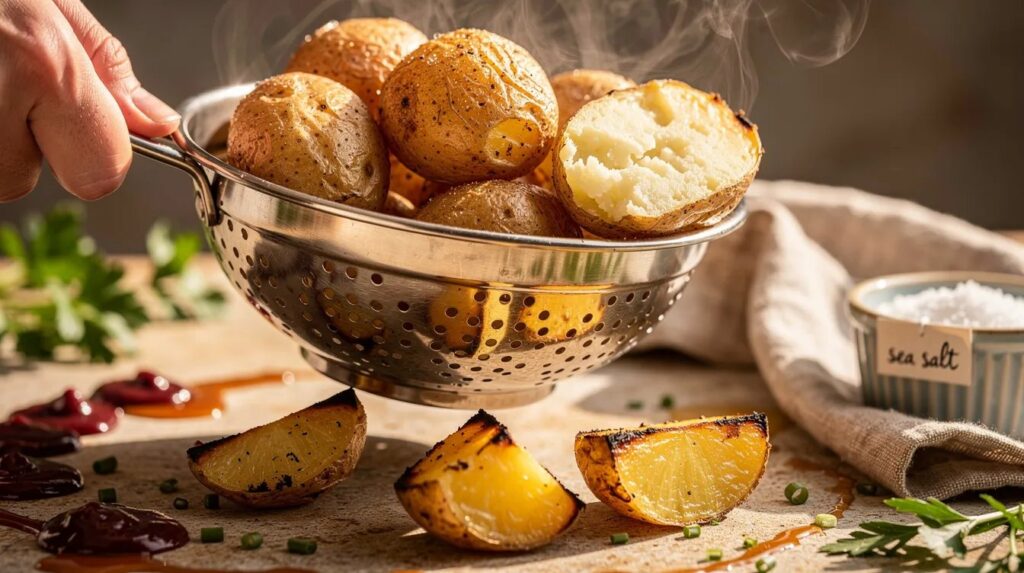
Bring a large pan of well-salted water to a rolling boil, then add ½ tsp of bicarbonate of soda. This is the step most people skip, and it is the one that changes the result entirely. Bicarbonate of soda raises the alkalinity of the cooking water, which accelerates the breakdown of pectin on the potato's surface. Pectin — the structural compound that holds plant cells together — normally keeps the outer layer of the potato smooth and intact. Alkaline water dissolves it faster, creating a rough, almost paste-like surface slurry on the potato chunks as they parboil. Add the potato pieces and cook for exactly 8–10 minutes: the edges should be starting to fray and turn translucent, while the very centre stays firm when tested with a knife tip. Drain immediately into a colander.
3. The steam-off and roughing up
Once drained, return the potatoes to the empty, dry saucepan and leave the lid off for 2 full minutes. This allows residual steam to escape — moisture is the enemy of crispness, and any water still clinging to the surface will create a soft, soggy barrier between potato and fat. After two minutes, give the saucepan a firm shake: the potato chunks will jostle against each other, and that already-softened surface slurry will rough up beautifully into a cragged, shaggy exterior. If using, dust with 1 tsp of semolina at this stage and shake again. The semolina acts like tiny breadcrumbs, amplifying the surface texture and giving the fat even more to grip onto.
4. Heat the fat until it smokes
Place your roasting tin in the oven and heat to 220°C / 200°C fan / Gas 7. Add the fat — goose fat gives the deepest flavour and the most golden crust, but sunflower oil works excellently and keeps the dish vegan — and heat it in the oven for at least 8 minutes, until it is visibly shimmering and the faintest wisp of smoke appears at the tin's edges. This stage is non-negotiable. A cold or merely warm fat will be absorbed into the potato surface rather than immediately sealing it: the result is a greasy, still-soft exterior. The sudden contact between a rough, dry potato surface and screaming-hot fat triggers an immediate Maillard reaction — the same browning process responsible for the crust on a good steak or the colour of a well-baked loaf.
5. Roast with discipline
Carefully remove the roasting tin from the oven and, working quickly, lower the potato pieces into the hot fat using a slotted spoon. They will spit and sizzle loudly — that sound is the crust forming in real time. Tuck the crushed garlic cloves and rosemary sprigs around the potatoes. Season with fine salt and black pepper. Roast at 220°C / 200°C fan for 25 minutes, then turn each piece using a fish slice — not tongs, which tend to tear the crust — and roast for a further 20–25 minutes until deeply golden, with some edges tipping towards amber. Do not open the oven during the first 25 minutes: the sudden drop in temperature stalls the crisping process and releases steam back into the tin.
Chef's tip
If you are cooking ahead for a large gathering — Easter Sunday often calls for industrial quantities — parboil and rough up the potatoes up to four hours in advance, leave them uncovered on a tray at room temperature, and only commit them to the hot fat when you are ready to roast. The air-drying time only helps. In spring and early summer, try replacing the rosemary with fresh thyme and adding the grated zest of half a lemon to the potatoes just before serving: the brightness cuts through the richness of the fat and lifts the whole dish.
Wine and drink pairings
Crispy roast potatoes are rarely served in isolation — they tend to accompany a larger roast, and the pairing should follow the main protein. That said, the fat used in the roasting shapes the flavour profile significantly: goose or duck fat brings a savouriness and depth that pairs well with structured, full-bodied wines.
Alongside a roast chicken or lamb, a white Burgundy (Mâcon-Villages or a village-level Meursault) works beautifully: its richness and gentle acidity match the fat without overwhelming it. For a beef roast, reach for a Côtes du Rhône rouge or a mid-weight Rioja Crianza. For a non-alcoholic alternative, a lightly sparkling apple juice from a single variety — Cox or Bramley — delivers enough acidity and freshness to hold its own alongside the richness of the dish.
The story behind the perfect roast potato
The roast potato as the British know it — golden, lard-crisped, piled alongside a Sunday joint — took its definitive form in the late Victorian era, when domestic coal ranges made high oven temperatures accessible to the ordinary household for the first time. Before that, potatoes were more commonly boiled, mashed, or cooked in the embers of an open fire. The Sunday roast itself, a cultural institution in England, Wales and Scotland, consolidated the roast potato's status as a non-negotiable component somewhere between the wars, when it became a weekly ritual for millions of families.
The debate over the perfect roast potato has never really stopped. Lard versus dripping versus goose fat; parboiled versus raw; floury versus waxy — these arguments surface at every Christmas table, every Easter gathering, every pub Sunday lunch. The bicarbonate of soda technique, though it may feel modern, is simply a more deliberate application of what cooks had understood for generations: that a rough, starchy surface and blistering heat are the two conditions that cannot be compromised. The ten minutes of active preparation described here are, in reality, a codification of accumulated kitchen wisdom.
Nutritional values (per portion, approximate values)
| Nutrient | Amount |
|---|---|
| Calories | ~320 kcal |
| Protein | ~4 g |
| Carbohydrates | ~42 g |
| of which sugars | ~2 g |
| Fat | ~14 g |
| Fibre | ~4 g |
Frequently asked questions
Can i prepare the potatoes in advance?
Yes — and in fact, it helps. Parboil, drain and rough up the potatoes as described, then spread them on a tray and leave them uncovered at room temperature for up to four hours. The surface will dry further, which only improves the final crunch. Do not refrigerate at this stage: the condensation that forms when cold potatoes meet hot fat will undo the drying work entirely. Heat your fat and roast from room temperature when ready.
How should i store leftovers?
Leftover roast potatoes keep well in an airtight container in the refrigerator for up to three days. To reheat and restore the crust, spread them on a baking tray and place in a hot oven — 200°C / 180°C fan — for 12–15 minutes. A microwave will soften the crust irreparably. Alternatively, leftover roast potatoes make a fine base for a Spanish-style tortilla: slice, fry briefly in olive oil, and fold into beaten eggs.
What substitutions work if i do not have goose fat?
Sunflower or vegetable oil are the most effective substitutes: their high smoke point means they tolerate the heat required without burning, and they allow the potato's own flavour to come through clearly. Olive oil can be used, but its lower smoke point and stronger flavour alter the result noticeably. Lard, though rarely stocked in modern British kitchens, produces a crust almost as good as goose fat and is worth seeking out at a traditional butcher. Coconut oil works for a vegan version, though it introduces a faint sweetness.
Does the type of roasting tin matter?
Significantly, yes. A heavy-gauge metal tin — stainless steel, aluminium, or a seasoned carbon steel — conducts and retains heat far more efficiently than ceramic or glass. The fat heats evenly and to a higher temperature in a metal tin, which is what creates immediate searing contact when the potatoes go in. A ceramic dish tends to have hot and cool spots, and the fat rarely reaches the temperature needed. If in doubt, a simple £8 aluminium roasting tin from a hardware shop will outperform an expensive ceramic dish here every time.
Why are my potatoes sticking to the tin?
Sticking almost always means the fat was not hot enough when the potatoes went in, or the potatoes were moved too soon. Once the potatoes hit properly hot fat, a crust begins to form almost immediately and acts as a natural release layer. If you try to move a potato that has not yet formed its crust, it will tear away from the tin and leave a sticky residue. Leave them undisturbed for the full first 25 minutes. If the problem persists, increase the fat quantity slightly and make sure the tin is fully preheated before the potatoes are added.