

March arrives with a particular kind of restlessness in the kitchen — the days stretch a little longer, Saint Patrick's Day still hangs in the air, and there is a craving for something indulgent yet effortless. A no bake Irish cream cheesecake answers all of it at once: the silky, barely-set filling carries the warm, whiskey-and-coffee notes of Baileys Irish Cream, while a crushed biscuit base adds the crunch and butterscotch depth that grounds every forkful. No oven required, no water bath, no anxiety. Just a mixing bowl, a springform tin, and a little patience while the fridge does the work.
This version leans into the character of the Irish cream liqueur rather than masking it. The filling is set with gelatine — enough to hold a clean slice, not so much that it becomes rubbery — and whipped cream is folded through to keep the texture light and almost mousse-like. The base is built from digestive biscuits, which are the natural British companion to anything creamy and rich. Whether you are making this for a Saint Patrick's Day gathering, a dinner party that needs a showstopping centrepiece, or simply a weekend treat, the recipe is forgiving and the result is genuinely impressive. Tie on your apron and clear a shelf in the fridge.
| Preparation | 30 min |
| Setting time | 6 hours minimum (overnight ideal) |
| Portions | 10–12 slices |
| Difficulty | Easy |
| Cost | ££ |
| Season | Spring — ideal around Saint Patrick's Day (17 March); suits year-round entertaining |
Suitable for: Vegetarian
Ingredients
For the biscuit base
- 300 g digestive biscuits
- 130 g unsalted butter, melted
- 1 tbsp dark brown soft sugar
For the cheesecake filling
- 600 g full-fat cream cheese, at room temperature
- 150 g icing sugar, sifted
- 150 ml Baileys Original Irish Cream (or equivalent Irish cream liqueur)
- 1 tsp good-quality vanilla extract
- 300 ml double cream, cold
- 2½ tsp powdered gelatine (or 4 sheets of leaf gelatine)
- 3 tbsp cold water (for blooming the gelatine)
To finish
- 150 ml double cream, whipped to soft peaks
- 2 tbsp Baileys Irish Cream, for drizzling (optional)
- Dark chocolate shavings or cocoa powder, for dusting
- A small handful of crushed chocolate-covered coffee beans (optional)
Utensils
- 23 cm (9-inch) springform cake tin
- Food processor or zip-lock bag and rolling pin
- Large mixing bowl
- Electric hand whisk or stand mixer
- Small heatproof bowl or ramekin (for the gelatine)
- Rubber spatula
- Palette knife
- Fine sieve
- Cling film
Preparation
1. Build the biscuit base
Start by lining the base of your springform tin with a disc of baking parchment — this makes unmoulding considerably easier later. Blitz the digestive biscuits in a food processor until they resemble fine, even crumbs; there should be no large shards left, as uneven pieces will cause the base to crack when sliced. If you do not have a food processor, seal the biscuits inside a sturdy zip-lock bag and use a rolling pin to crush them methodically, working from the centre outward. Tip the crumbs into a bowl, add the dark brown sugar, then pour over the melted butter. Stir thoroughly until every crumb is coated and the mixture looks like damp sand. Press the mixture firmly and evenly into the base of the prepared tin using the back of a spoon or the flat base of a glass — the more compact this layer, the cleaner the slice. Transfer to the fridge to firm up for at least 30 minutes while you prepare the filling.
2. Bloom and dissolve the gelatine
Measure 3 tablespoons of cold water into a small heatproof bowl or ramekin. Sprinkle the powdered gelatine evenly over the surface — do not stir — and leave it to bloom (absorb the liquid and swell) for 5 minutes. If using leaf gelatine, submerge the sheets individually in a bowl of cold water for 5 minutes until soft and pliable, then squeeze out the excess water before proceeding. Once bloomed, place the bowl over a small saucepan of barely simmering water and stir gently until the gelatine has dissolved completely into a clear, lump-free liquid. Remove from the heat and allow it to cool to approximately room temperature — it should feel neither hot nor cold to the touch. Gelatine incorporated while too warm will knock the air from your filling; too cool and it will set unevenly in streaks.
3. Beat the cream cheese base
In a large mixing bowl, beat the full-fat cream cheese with an electric hand whisk on medium speed until it is completely smooth and pliable — this takes roughly 2 minutes. Cold cream cheese will leave lumps that no amount of whisking will fully fix, which is why bringing it to room temperature beforehand matters. Sift in the icing sugar and beat again until incorporated, scraping down the sides of the bowl with a rubber spatula. Add the Baileys and the vanilla extract, then beat for a further minute. The mixture will loosen noticeably and take on a pale coffee-cream colour; the aroma at this stage — warm caramel, a trace of whiskey, faint cocoa — suggests that the filling is developing perfectly.
4. Whip the cream and combine
In a separate cold bowl, whip the 300 ml of double cream to soft peaks — meaning the cream holds its shape when the whisk is lifted but the tip gently folds over rather than standing rigid. Overwhipped cream will make the finished cheesecake grainy rather than silky; stop frequently to check. With the gelatine mixture at room temperature, stir a large spoonful of the cream cheese mixture into the gelatine first — this tempers it, preventing the gelatine from setting in threads on contact with the cooler mixture. Pour the tempered gelatine back into the cream cheese bowl and stir to combine. Now fold in the whipped cream in two stages using a large rubber spatula, working with slow, confident strokes from the bottom of the bowl upward to preserve as much air as possible. The finished filling should be smooth, mousse-like, and drop heavily from the spatula.
5. Fill, smooth, and refrigerate
Remove the tin from the fridge. Pour the filling over the biscuit base, then use a palette knife or the back of a spoon to smooth the surface flat. A slight dome is fine — it will settle as it chills. Wrap the tin loosely in cling film and place it on a level shelf in the fridge for a minimum of 6 hours, though overnight produces a noticeably firmer, more cleanly sliced result. Do not attempt to rush this stage in the freezer; the texture becomes icy and the gelatine sets unevenly.
6. Unmould and decorate
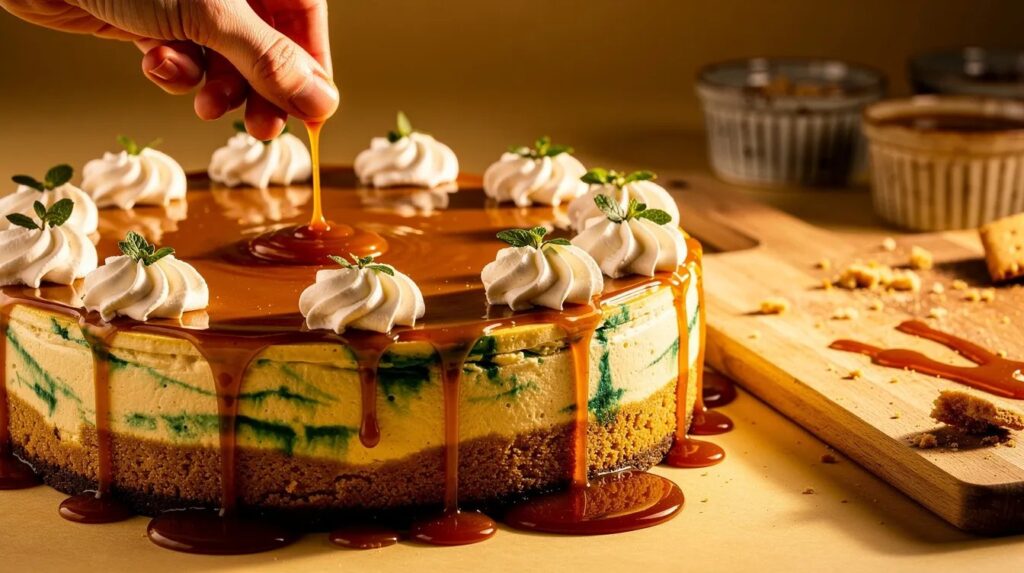
When the cheesecake has set completely, run a thin palette knife or the blade of a sharp, warm knife around the inside edge of the tin before releasing the springform clip. Lift the cheesecake onto a serving plate or cake stand. Spoon or pipe the softly whipped finishing cream across the top — either in a smooth even layer or in loose rosettes around the edge. Dust generously with cocoa powder or scatter fine dark chocolate shavings using a vegetable peeler drawn across a good block of 70% dark chocolate. A few crushed chocolate-covered coffee beans add a welcome bitterness and crunch if you are serving this to guests. Drizzle a thin thread of Baileys over the cream just before serving if you want a bolder hit of liqueur at the table.
My chef's tip
The single most common reason a no bake cheesecake fails to slice cleanly is insufficient chilling time — the gelatine needs a full overnight rest to achieve the right tension throughout the filling. For an even crisper finish, dip your slicing knife in hot water and wipe it dry between each cut. In early spring, when good-quality strawberries are just beginning to appear at farm shops and market stalls, a few sliced alongside each portion cuts beautifully through the richness of the filling and adds a welcome brightness. If you want to intensify the Irish cream flavour without adding more liquid, stir a teaspoon of good instant espresso powder into the cream cheese mixture alongside the Baileys — it deepens the coffee character without making the cheesecake taste of coffee outright.
Drinks to serve alongside
The filling carries pronounced notes of caramel, cream, coffee, and a quiet warmth from the whiskey base of the Irish cream. The decoration adds a slight bitterness from the dark chocolate. You want a drink that complements without competing.
A small pour of Baileys itself, served over ice, is the most direct accompaniment and pleases a crowd. For a wine pairing, a chilled Muscat de Beaumes-de-Venise from the Rhône Valley brings apricot and honeyed depth that holds its ground against the cream cheese richness. A Pedro Ximénez sherry — dark, raisin-thick, syrupy — is another strong match if you are serving in smaller quantities after dinner. For a non-alcoholic option, a well-made flat white or a cold brew coffee works with the same logic: the bitterness of coffee balances the sweetness of the filling in exactly the way dark chocolate does.
A little history
Baileys Original Irish Cream was launched in 1974 by Gilbeys of Ireland and became the first Irish cream liqueur to achieve widespread international distribution — a combination of Irish whiskey, cream, and cocoa that was initially viewed with scepticism by the spirits industry and went on to become one of the bestselling liqueurs in the world. Its entry into British baking and dessert-making was gradual but now feels entirely natural, particularly around Saint Patrick's Day when supermarket shelves across the UK fill with Baileys-laced tray bakes, brownies, and mousses. The no bake cheesecake format itself has British roots: the chilled, biscuit-based cream cheese set with gelatine became a staple of British home cooking during the 1970s and 1980s, when cream cheese grew more widely available and the format offered a forgiving alternative to the baked American-style cheesecake. Combining the two traditions produces something that feels genuinely at home in a British kitchen — richer than a lemon no bake, more festive than a plain vanilla, and immediately recognisable by the pale caramel colour of the filling and the scent that rises from the tin.
Variations on this recipe appear across Ireland, the UK, and the United States in different proportions. Some versions skip the gelatine entirely and rely on very stiffly whipped cream and a long freeze to hold the filling, which produces a texture closer to semifreddo. Others fold through crushed chocolate biscuits or chunks of fudge for a more textured result. A chocolate biscuit base — made with Oreos or chocolate digestives — replaces the plain digestive when a stronger cocoa presence is wanted throughout. For a lighter spring version, the Baileys can be reduced to 100 ml and a tablespoon of finely grated orange zest stirred through to lift the filling with citrus brightness.
Nutritional values (per slice, based on 12 portions, approximate values)
| Nutrient | Amount |
|---|---|
| Calories | ~490 kcal |
| Protein | ~6 g |
| Carbohydrates | ~34 g |
| of which sugars | ~22 g |
| Fat | ~36 g |
| of which saturates | ~22 g |
| Fibre | ~1 g |
| Alcohol | ~3 g (from Irish cream) |
Frequently asked questions
Can this cheesecake be made in advance?
Yes — and it is actively better for it. The filling firms up and the flavours meld more deeply after a full night in the fridge. You can make the cheesecake up to two days ahead of serving, keeping it covered in the tin in the fridge without the cream decoration. Add the whipped cream topping and chocolate shavings on the day you plan to serve it, as cream can weep slightly and cocoa powder absorbs moisture over time.
How should leftovers be stored?
Cover any remaining slices loosely with cling film and refrigerate for up to 3 days. The texture remains stable thanks to the gelatine, though the biscuit base softens slightly over time as it absorbs moisture from the filling — this is normal and does not affect the flavour. The cheesecake is not suitable for freezing once decorated, as the whipped cream topping will collapse on thawing.
Can the gelatine be replaced with a vegetarian alternative?
Agar-agar is the most common vegetarian substitute, derived from seaweed. Use approximately 1½ tsp of agar-agar powder in place of the 2½ tsp powdered gelatine, dissolved in the water and simmered for 2 minutes rather than simply heated. Bear in mind that agar sets more firmly than gelatine and does not melt on the palate in the same way, which gives a slightly denser, less creamy mouthfeel — still pleasant, but noticeably different. Vegetarian gelatine alternatives based on carrageenan are also available from health food shops and some supermarkets.
What if my filling does not set properly?
The most likely cause is gelatine that was not fully dissolved before being added to the filling, or gelatine that was too hot when incorporated and damaged the structure of the whipped cream. If the cheesecake is still loose after 6 hours, return it to the fridge and allow a further 4–6 hours — occasionally it simply needs more time. If it has been chilling for more than 12 hours and is still soft enough to pour, the gelatine quantity was likely insufficient or was not activated correctly. In this case, the filling can be repurposed as a Baileys mousse served in glasses.
Is there a version without alcohol?
Yes. Replace the Baileys with 100 ml of strong cold brew coffee combined with 50 ml of single cream and a tablespoon of caramel sauce. This replicates much of the coffee-and-caramel character of the Irish cream without the alcohol, making the cheesecake suitable for children and those avoiding alcohol. A splash of good-quality coffee extract also works well if cold brew is not to hand.