



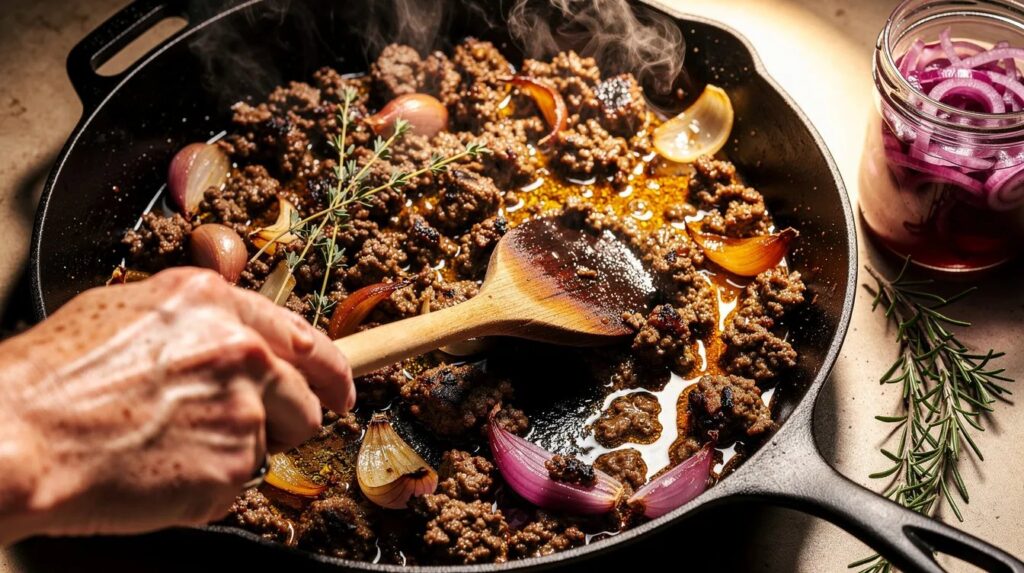
March is a strange month in the British kitchen — the mornings still bite, the evenings draw out just long enough to tease, and the urge to cook something deeply satisfying hasn't quite given way to lighter spring instincts. Ground beef is exactly what this moment calls for: affordable, versatile, and capable of extraordinary things when handled with even a little know-how. The problem is that most home cooks rush it — blasting mince in a hot pan and ending up with dry, grey crumbles that taste of not very much at all.
There is one technique that changes everything, and once you understand the logic behind it, you will never go back to the old way. It involves a single unexpected step before the beef ever hits the pan — one that locks in moisture, deepens flavour, and produces a texture closer to slow-cooked Bolognese than a weeknight scramble. This guide walks you through the complete method, from choosing the right mince at the butcher's counter to the final seasoning, with the kind of detail that makes the difference between a meal you forget and one you genuinely look forward to repeating.
| Preparation | 10 min |
| Resting | 15 min |
| Cooking | 20 min |
| Serves | 4 people |
| Difficulty | Easy |
| Cost | £ |
| Season | Early spring — pairs well with new-season leeks, spring onions, flat-leaf parsley |
Suitable for: High in protein · Dairy-free · Gluten-free (check stock labels)
Ingredients
- 500 g beef mince, 15–20% fat (not extra-lean)
- 1 tsp fine sea salt, for the brine
- 150 ml cold water
- 1 medium white onion, finely diced
- 3 garlic cloves, minced
- 1 tbsp neutral oil (sunflower or vegetable)
- 1 tbsp tomato purée
- 1 tsp Worcestershire sauce
- ½ tsp smoked paprika
- ½ tsp freshly ground black pepper
- 1 small bunch of flat-leaf parsley, roughly chopped (to finish)
Utensils
- Large mixing bowl
- Wide, heavy-based frying pan or cast-iron skillet
- Wooden spoon or stiff silicone spatula
- Sharp knife and chopping board
- Kitchen scales
- Measuring jug
Preparation
1. Brine the beef before it touches any heat
This is the step that most recipes skip entirely, and it is the one that makes the greatest difference. Measure 150 ml of cold water into your mixing bowl and dissolve 1 teaspoon of fine sea salt into it, stirring until completely clear. Add the beef mince directly into this brine and work it gently with your hands for about 60 seconds — not kneading it hard, just folding and pressing so the liquid is absorbed throughout the meat. The technique draws on the same principle used in Chinese stir-fry cookery, sometimes called velveting: salt denatures the surface proteins just enough to help the muscle fibres retain moisture under heat, rather than squeezing it out. You will notice the mixture looks slightly wetter and more cohesive than raw mince normally does. Cover the bowl with a plate and refrigerate for 15 minutes. This rest period is not optional — it gives the salt time to penetrate and the proteins time to reorganise.
2. Build your aromatic base low and slow
While the beef rests, place your wide pan over a medium-low flame and add the oil. Once it shimmers — you are looking for gentle movement, not smoking — add the finely diced onion. Cook it slowly for 8 to 10 minutes, stirring occasionally, until the pieces are completely translucent and just beginning to colour at the edges. Rushing this stage produces a sharp, aggressive sweetness; patience here delivers a mellow, rounded depth. Add the minced garlic and the smoked paprika, and cook for a further 2 minutes, stirring constantly so the garlic softens without browning. The pan at this point should smell like something between a French onion soup and a Spanish sofrito — sweet, faintly smoky, deeply savoury.
3. Add the beef — and resist the urge to stir
Increase the heat to medium-high. Remove the beef from the brine — do not drain it; carry it across with whatever liquid clings to it — and press it into the pan in one rough layer, as flat as you can manage. Leave it completely undisturbed for 3 to 4 minutes. You are waiting for the underside to develop a proper sear: that deep mahogany crust that forms when the Maillard reaction — the browning of amino acids and sugars under dry heat — runs its course. Listen for a steady sizzle; if it sounds wet and steaming, the heat is too low. Once the underside is well coloured, break the mince apart with your spatula into rough, irregular chunks rather than fine crumbles. These uneven pieces have more surface area variation, which means some edges stay slightly crisp while the centres remain tender.
4. Finish with tomato purée and Worcestershire sauce
Once the beef is broken up and most of the pink has gone — around 2 to 3 minutes after breaking — push it to the sides of the pan to expose the centre. Add the tablespoon of tomato purée directly onto the hot surface and let it fry in the residual fat for 60 to 90 seconds, stirring only the purée until it darkens by one shade and smells slightly caramelised. This step is called pinçage in classical French technique and it dramatically reduces the raw, acidic edge of tomato, converting it into something richer and more concentrated. Stir the purée through the beef, add the Worcestershire sauce and the black pepper, and toss everything together over the heat for a final 2 minutes. Taste and adjust salt at this point only — the brine will have seasoned the meat from the inside, so you may need less than you expect.
5. Rest briefly, then scatter with parsley
Take the pan off the heat and allow the beef to rest for 2 minutes before serving — just long enough for the juices that have been driven to the surface by heat to redistribute back through the meat. Scatter the roughly chopped flat-leaf parsley across the top. The sharp, green freshness of the parsley is not decorative; it cuts through the richness of the fat and lifts the entire dish. In early spring, when bunches of parsley at market stalls are particularly vibrant and fragrant, this finishing touch feels especially considered.
My chef's tip
The single most common error with mince is choosing meat that is too lean. Extra-lean beef (below 10% fat) has almost no lipid content to carry flavour or lubricate the proteins during cooking — the result is inevitably dry and chalky. Look for mince labelled 15–20% fat; your butcher may call it "chuck mince" or "shoulder mince". At this time of year, when some butchers begin receiving younger spring cattle, the mince often has a cleaner, slightly sweeter flavour than winter stock. Ask — they will tell you what came in that week. And if you happen to have a splash of red wine open on the counter, deglaze the pan with 50 ml after the sear and before the tomato purée: it adds a quiet background depth that makes the dish feel considerably more complex.
Food and drink pairings
The cooked beef here is savoury, faintly smoky, and carries a slight umami richness from the Worcestershire and tomato. You want a drink that matches that weight without overwhelming it.
A medium-bodied red works best — a Côtes du Rhône or a Chilean Carménère both carry enough dark fruit and earthy tannin to complement the beef without competing with the parsley's brightness. If you prefer something closer to home, a Côtes de Gascogne rouge at a modest price point is quietly excellent here. For a non-alcoholic option, a good quality tomato juice seasoned with a little celery salt and black pepper mirrors the umami notes in the beef and holds the pairing together surprisingly well.
A little background on the technique
The practice of brining meat before dry-heat cooking has existed in various culinary traditions for centuries, but it gained wider recognition in Western home cooking relatively recently, partly through the work of food scientists like Harold McGee, whose writing on the physics and chemistry of cooking brought laboratory logic into domestic kitchens. The specific application to mince — rather than whole cuts — is a more recent adaptation, borrowed in part from the Chinese technique of velveting, where proteins are treated with alkaline or saline solutions before high-heat cooking to produce unusual tenderness.
Ground beef itself has a long history in British cooking, particularly in the form of cottage pie and mince and tatties — dishes born from the practical need to extend cheaper cuts of meat. The French equivalent, bœuf haché, developed its own distinct traditions around bistro cooking. What all these traditions share is that mince, if handled carefully, is not a lesser ingredient but a genuinely expressive one — capable of absorbing seasoning deeply and rewarding technique generously. This brining method sits squarely within that tradition: not a gimmick, but a logical extension of what good cooks have always known about salt and patience.
Nutritional values (per serving, approximate values)
| Nutrient | Amount |
|---|---|
| Calories | ~310 kcal |
| Protein | ~26 g |
| Carbohydrates | ~5 g |
| of which sugars | ~3 g |
| Fat | ~20 g |
| Fibre | ~1 g |
Frequently asked questions
Can i prepare this ahead of time?
Yes — the cooked mince keeps well and actually improves slightly after a night in the refrigerator, as the seasoning continues to distribute through the meat. Cook it fully, allow it to cool completely, then store in an airtight container for up to 3 days in the fridge. Reheat gently in a pan with a splash of water or stock over medium-low heat, stirring until warmed through. Avoid the microwave if possible — it tends to drive out the moisture the brine worked to retain.
How should i store leftovers?
Transfer cooled mince to an airtight container and refrigerate within 2 hours of cooking. It will keep for up to 3 days in the fridge or up to 3 months in the freezer — portion it into flat freezer bags for faster thawing. Defrost overnight in the fridge rather than at room temperature, and reheat to a core temperature of at least 75°C before serving.
What substitutions or variations work well?
The brine technique works equally well with lamb mince — particularly good in early spring when British lamb is at its youngest and most delicate — or with pork mince if you prefer a slightly sweeter, fattier result. For a leaner option, turkey mince benefits enormously from brining, as it has almost no natural fat to protect it from drying out. For different flavours, try swapping the smoked paprika for ground cumin and coriander for a Middle Eastern dish, or for fennel seeds and dried chilli for an Italian sausage-style flavour.
What should i serve this with?
The beef is deliberately versatile — it works over steamed white rice, tucked into a warm flatbread, spooned onto creamy mashed potato, or stirred through pasta. In spring, it pairs particularly well with a simple side of wilted spring greens or buttered leeks, both of which are at their best in March. For a more substantial plate, a fried egg on top adds richness and turns it into a satisfying one-bowl dinner.
Why use 15–20% fat mince rather than extra-lean?
Fat is not merely a caloric concern here — it is a functional ingredient. During cooking, the lipids in fattier mince melt and coat the muscle fibres, providing both lubrication and flavour-carrying capacity. Extra-lean mince (5% fat or below) lacks this mechanism entirely, and even the most careful brining cannot fully compensate for the absence of fat. The caloric difference between 15% and 5% fat mince per serving is approximately 60–80 kcal — a meaningful but not prohibitive difference for most eating patterns.