


Spring has quietly arrived, and with it comes that welcome instinct to cook something honest and satisfying without spending an afternoon in the kitchen. The Spanish omelette — tortilla española in its homeland — answers that call with a confidence built on centuries of repetition. Four ingredients, one pan, and a technique that rewards patience rather than speed. It is the kind of dish that looks deceptively simple, then surprises you with how much flavour it carries per forkful.
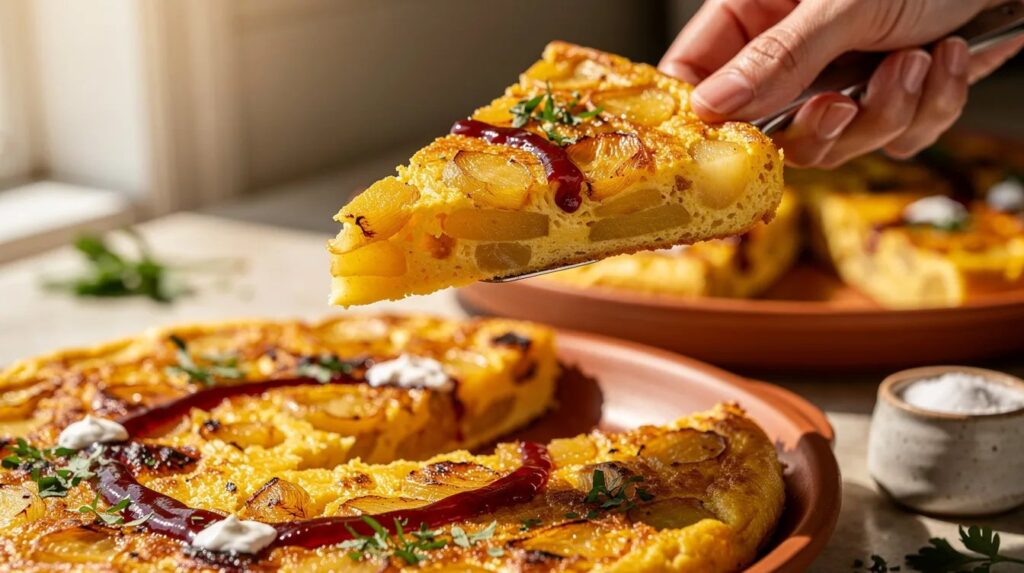
This version stays true to the classic: potatoes, eggs, onion, and good olive oil — nothing more, nothing less. What makes it worth making at home is understanding the why behind each step: why the potatoes are cooked slowly in oil rather than boiled, why the eggs must rest, and why the flip, that single nerve-testing moment, changes everything. Master these, and you will produce a tortilla that is golden on the outside, just set at its edges, and trembling with a soft, custardy centre. Apron on.
| Preparation | 15 min |
| Cooking | 40 min |
| Resting | 5 min |
| Portions | 4–6 people |
| Difficulty | Medium |
| Cost | £ |
| Season | Spring — waxy new-season potatoes, mild onions |
Suitable for: Vegetarian · Gluten-free · High in protein
Ingredients
- 750 g waxy potatoes (such as Charlotte or Maris Peer), peeled and thinly sliced
- 1 medium white or yellow onion, halved and thinly sliced
- 6 large free-range eggs
- 200 ml good-quality olive oil (not extra virgin — a mild, light olive oil works best here)
- 1 tsp fine sea salt, plus more to taste
- Black pepper, freshly ground
Utensils
- 20–22 cm non-stick frying pan (straight sides preferred)
- Large mixing bowl
- Slotted spoon or spider skimmer
- Flat plate or pan lid slightly wider than the frying pan
- Sharp knife and chopping board
- Kitchen paper
Preparation
1. Slice the potatoes and onion
Peel the potatoes and slice them as evenly as possible, aiming for rounds approximately 3–4 mm thick — thin enough to cook through gently, thick enough to hold their shape. A mandoline makes this easier, though a sharp knife and a steady hand work perfectly well. Halve the onion and slice it finely into half-moons. There is no need to keep the potato and onion separate at this stage; combine them in a bowl and season with the teaspoon of salt. The salt begins drawing out moisture immediately, which is exactly what you want — it will help the vegetables soften in the oil without taking on colour too quickly.
2. Confit the potatoes in olive oil
Pour the olive oil into your frying pan and set it over a medium-low heat. When the oil shimmers gently — you are not looking for aggressive bubbling — lower in the potato and onion mixture. They should be mostly submerged, or very nearly so. This process is closer to confit than frying: the vegetables cook slowly and gently in oil at roughly 120–130°C, becoming tender rather than crisp. Stir occasionally with a slotted spoon to prevent any sticking. After 20–25 minutes, the potatoes will be completely tender, yielding easily when pressed, and the onion will have turned translucent and sweet. The oil will have taken on a pale golden warmth. Remove everything with a slotted spoon and leave to drain on kitchen paper. Reserve the oil — it is now deeply flavoured and can be strained and reused.
3. Beat the eggs and combine
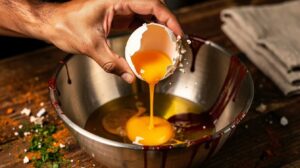
Crack the six eggs into a large bowl and beat them firmly with a fork until fully combined — you want a uniform, slightly frothy mixture with no streaks of white remaining. Season with salt and a few turns of black pepper. Tip the drained potato and onion mixture directly into the beaten eggs. Stir gently to coat every piece, then leave the mixture to rest for 5 minutes. This resting period is not decorative — it allows the eggs to begin setting around the potatoes slightly, giving the finished tortilla a more cohesive, sliceable texture rather than a crumbly one.
4. Cook the first side
Return the frying pan to a medium heat and add roughly 2 tablespoons of the reserved olive oil. When the oil begins to move fluidly across the pan surface, pour in the egg and potato mixture, spreading it evenly with the back of a spoon. Reduce the heat to medium-low immediately. Run a spatula around the edges of the tortilla every minute or so, gently drawing the cooked egg inward and allowing the liquid egg on top to flow to the edges. After 6–8 minutes, the sides should be set, the base a deep golden brown when you carefully lift one edge with the spatula, and the top still slightly liquid at its centre — this is correct. Slide the pan from the heat.
5. The flip
Place a flat plate or a lid — one that comfortably covers the full diameter of the pan — directly on top of the tortilla. Hold the plate firmly against the pan rim with your non-dominant hand. In one confident, smooth motion, invert the pan so the tortilla drops onto the plate, uncooked side down. Hesitation causes accidents; a decisive movement keeps everything intact. Slide the tortilla back into the pan, uncooked side now facing the heat. Return the pan to medium-low and cook for a further 3–4 minutes. The exterior should be uniformly golden; the interior, when you press gently at the centre, should feel just barely set — cuajada pero jugosa, as they say in Spain: set but still juicy. Remove from the heat and rest for 5 minutes before serving.
My chef's tip
The single most common mistake with tortilla española is overcooking it. The centre should tremble when you lift the pan — almost like a set crème caramel. It will continue to firm up off the heat during resting, and a cold slice the next day will be even better, the flavours having had time to settle into one another. In spring, try replacing a quarter of the potato with thinly sliced young leeks or a handful of fresh peas stirred into the egg mixture: they cook in the residual heat and add a green, seasonal brightness without altering the character of the dish.
Food & drink pairings
The tortilla has a richness built from egg yolk and olive-oil-soaked potato, balanced by the natural sweetness of slow-cooked onion. You want a wine that cuts gently through that richness without overpowering the subtle, earthy quality of the dish.
A chilled Fino or Manzanilla Sherry from Andalusia is the traditional pairing — its saline, almond-edged dryness is practically made for tortilla. For a still wine, a young Albariño from Galicia or a crisp, unoaked Verdejo from Rueda work beautifully, their citrus acidity cutting through the egg yolk. If you prefer red, a light, low-tannin Mencía served slightly cool is a good match. For a non-alcoholic option, a good sparkling water with a slice of lemon alongside a cold glass of gazpacho maintains the Spanish spirit of the meal.
A little history
The tortilla española appears in written records from the early 19th century in Spain, though its exact origins remain a subject of friendly debate between regions — Navarre and Extremadura both lay claim to it. What is certain is that it emerged as a peasant dish: potatoes, abundant after their introduction from the Americas, stretched a small number of eggs into a meal that could feed an entire household. Its economy was its genius. Today it is eaten at every hour of the day across Spain — cut into wedges for tapas, packed into bread rolls as bocadillo de tortilla for lunch, or served warm as a main course with a simple green salad.
Debates persist among Spaniards about one defining question: con cebolla o sin cebolla — with onion or without? Purists in some regions insist the onion has no place; the majority of home cooks, and this recipe, disagree. Onion, cooked slowly enough to lose all sharpness, adds a gentle sweetness and depth that a potato-and-egg-only version simply cannot match. Modern variations introduce chorizo, roasted peppers, or spinach, but the original four-ingredient version remains the one most likely to stop a table's conversation mid-sentence.
Nutritional values (per serving, approximate values)
| Nutrient | Amount |
|---|---|
| Calories | ~310 kcal |
| Protein | ~13 g |
| Carbohydrates | ~22 g |
| of which sugars | ~2 g |
| Fat | ~19 g |
| Fibre | ~2 g |
Frequently asked questions
Can I make tortilla española ahead of time?
Absolutely — in fact, it improves with time. Cook it fully, allow it to cool to room temperature, then wrap tightly and refrigerate. The flavours meld and deepen overnight, and many Spaniards consider a day-old tortilla superior to a freshly made one. Serve it cold or at room temperature; reheating is possible but tends to firm the texture beyond the ideal soft centre.
How should I store leftovers?
Wrap the tortilla tightly in cling film or store in an airtight container in the refrigerator for up to 3 days. Do not freeze it — the egg texture becomes watery and grainy on thawing. Bring it back to room temperature for about 20 minutes before serving for the best texture and flavour.
What substitutions or variations are possible?
The potato variety makes a significant difference: waxy types such as Charlotte or Maris Peer hold their shape and offer a creamy bite, whereas floury varieties like King Edward tend to collapse into the egg, creating a denser, heavier result — not wrong, simply different. For a richer tortilla, add one extra egg yolk to the mix. In spring, young new-season potatoes need almost no peeling and cook in slightly less time; their flavour is noticeably sweeter. For a heartier version, fold in a handful of sautéed cooking chorizo or thinly sliced roasted red peppers before combining with the eggs.
My tortilla broke when I flipped it — what went wrong?
The two most common causes are an under-set base and a hesitant flip. The underside needs a full 6–8 minutes over medium-low heat before the flip — lift one edge with a spatula to check for a firm, golden crust before attempting to invert. The plate must be wider than the pan and held firmly against the rim; a small plate allows the edges to fall. The flip itself should be quick and decisive — a slow inversion gives the tortilla time to slide rather than turn cleanly.
How much oil do I really need?
More than feels comfortable at first glance. The 200 ml is not a typo — the potatoes must be mostly submerged to confit properly rather than fry. Most of that oil is drained off before cooking the tortilla itself, and the remainder can be strained, stored in a jar, and reused within a week for sautéing vegetables or dressing a salad. A tortilla made with too little oil produces dry, partially raw potatoes that never fully integrate with the egg.