



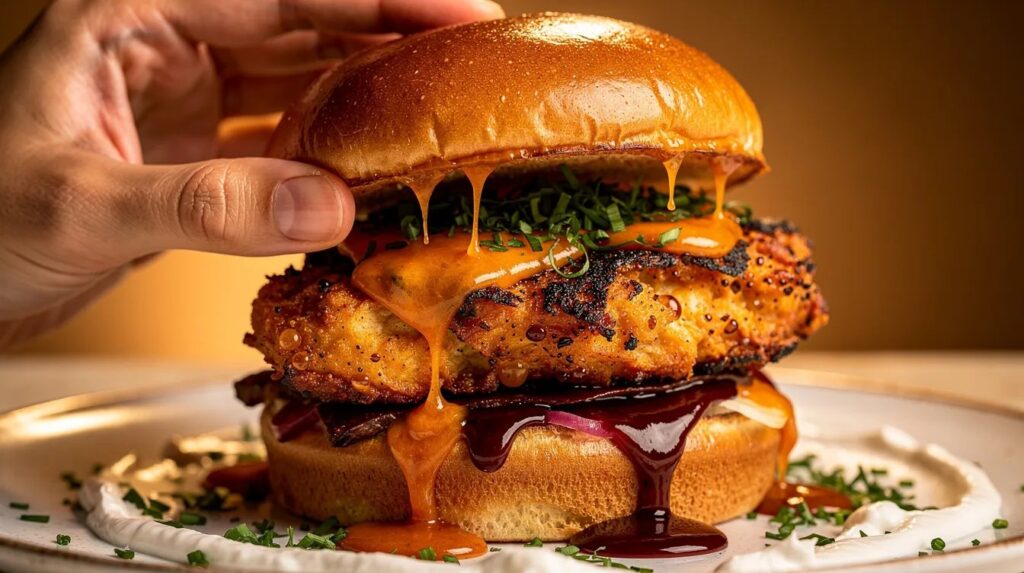
There's a specific hunger that only kicks in around midnight — the kind that no sensible meal can satisfy. In Ireland, that hunger has a name, and it comes stacked between two toasted buns with a shatteringly crisp chicken fillet, molten cheese, and enough sauce to make you forgive the cold walk home. The fried chicken sandwich isn't just fast food here; it's a ritual, a reward, a full stop at the end of a good night out. And as spring arrives in late March 2026, bringing longer evenings and more reasons to stay out late, that craving hits harder than ever.
This recipe nails the exact combination that makes Ireland's late-night chicken sandwich so compelling: a double-dredged fillet with a crunch you can hear across the room, a sticky, sharp cheese sauce that clings to every crevice, and a soft brioche bun that holds it all together without turning to mush. No shortcuts, no guesswork — just the technique that gets you there every single time. Tie on that apron.
| Preparation | 20 min |
| Marinating | 1 hour (or overnight) |
| Cooking | 20 min |
| Portions | 4 sandwiches |
| Difficulty | Medium |
| Cost | ££ |
| Season | Year-round · perfect for spring evenings |
Suitable for: Rich in protein
Ingredients
For the chicken
- 4 boneless, skinless chicken breasts (or thighs for extra juiciness)
- 500 ml buttermilk
- 1 tsp garlic powder
- 1 tsp smoked paprika
- 1 tsp cayenne pepper
- 1 tsp fine sea salt
- 1 tsp black pepper, freshly ground
For the dredge
- 250 g plain flour
- 80 g cornflour
- 1½ tsp baking powder
- 1½ tsp fine sea salt
- 1 tsp garlic powder
- 1 tsp smoked paprika
- ½ tsp white pepper
For the cheese sauce
- 30 g unsalted butter
- 30 g plain flour
- 300 ml whole milk
- 150 g mature Cheddar, grated (Irish Cheddar preferred)
- 1 tsp Dijon mustard
- Salt and white pepper to taste
To assemble
- 4 brioche buns, split and lightly toasted
- 4 leaves iceberg lettuce, shredded
- 2 large gherkins, sliced into rounds
- 2 tbsp mayonnaise
- 1 tbsp sriracha (optional)
- 1 litre vegetable or sunflower oil, for deep frying
Utensils
- Large mixing bowl
- Shallow wide dish or tray (for dredging)
- Deep, heavy-bottomed saucepan or Dutch oven
- Kitchen or probe thermometer
- Wire rack set over a baking tray
- Small saucepan (for cheese sauce)
- Tongs
- Meat mallet or rolling pin
Preparation
1. Butterfly and marinate the chicken
Place each chicken breast between two sheets of cling film and use a meat mallet or a rolling pin to pound them to an even thickness of approximately 2 cm. This step is non-negotiable: uneven thickness means part of the chicken overcooks before the rest is done. Once flattened, place the fillets in a large bowl. Combine the buttermilk with the garlic powder, smoked paprika, cayenne, salt, and black pepper, then pour it over the chicken. Make sure every fillet is fully submerged. Cover the bowl with cling film and refrigerate for at least 1 hour — overnight gives you noticeably more tender, flavour-saturated meat. The acidity of the buttermilk gently breaks down the muscle fibres, which is why this marinade produces a fillet that stays moist even through the heat of the fryer.
2. Prepare the dredge
In a wide, shallow dish — a baking tray works perfectly — whisk together the plain flour, cornflour, baking powder, salt, garlic powder, smoked paprika, and white pepper. The cornflour is the key to that brittle, almost glassy crust: it reduces the amount of gluten in the mix, which keeps the coating light and shatters cleanly when you bite through it. The baking powder introduces tiny air pockets during frying, lifting the crust away from the meat and creating those craggy ridges that hold the cheese sauce so well. Before you start dredging, add 2 to 3 tablespoons of the buttermilk marinade directly into the flour and rake it through with a fork. Those small clumps of wet flour are what create the particularly crunchy, uneven texture you're after.
3. Double-dredge the fillets
Remove the chicken from the buttermilk marinade, letting the excess drip off — though not too thoroughly. Press each fillet firmly into the flour mixture, making sure to coat the sides and any folds. Flip and press again. Now return it briefly to the buttermilk, let it pick up a thin layer, then press once more into the flour for the second dredge. This double-coating technique — two passes through the flour with a buttermilk dip in between — is what builds the architecture of the crust. Set the coated fillets on a wire rack and let them rest for 10 minutes. This resting period allows the coating to hydrate and adhere fully, so it doesn't slide off in the oil.
4. Heat the oil and fry
Pour the oil into a deep, heavy-bottomed saucepan to a depth of at least 8 cm. Heat it over a medium-high flame until it reaches 175°C — use a thermometer here; guessing leads to either a pale, greasy coating or a burnt crust with raw chicken inside. Carefully lower two fillets at a time into the oil using tongs. Overcrowding the pan causes the temperature to drop sharply, which means the chicken stews rather than fries and the crust absorbs oil rather than repelling it. Fry each fillet for 6 to 7 minutes, turning once halfway through, until the crust is a deep amber and the internal temperature of the chicken registers 75°C. Transfer to the wire rack — never to kitchen paper, which traps steam and softens the crust — and allow to rest while you finish the sauce.
5. Make the cheese sauce
Melt the butter in a small saucepan over a medium heat. Once it begins to foam, add the flour and stir constantly with a wooden spoon for 1 to 2 minutes, cooking out the raw flour taste. This mixture is called a roux — the foundation of most classical white sauces — and it needs that cooking time to develop a faintly nutty, neutral flavour. Gradually pour in the whole milk, a splash at a time initially, whisking vigorously after each addition to prevent lumps. Once all the milk is incorporated, cook for a further 3 to 4 minutes, stirring continuously, until the sauce coats the back of a spoon and leaves a clean line when you drag your finger across it. Remove from the heat. Add the grated Cheddar in three batches, stirring until fully melted each time, then stir in the Dijon mustard. Season with salt and white pepper. Keep warm over the lowest possible heat, stirring occasionally.
6. Assemble the sandwich
Split the brioche buns and toast them cut-side down in a dry frying pan over a medium heat until golden — this takes around 60 to 90 seconds and creates a barrier that stops the bun from absorbing the sauce too quickly. Spread a generous layer of mayonnaise on the base, then add the shredded iceberg lettuce and a few gherkin rounds. Place the hot chicken fillet directly on top. Spoon the cheese sauce over it generously — do not be cautious here. Add a drizzle of sriracha if you want heat, then press the top bun down firmly. Serve immediately.
My chef's tip
If you want to push the cheese flavour further, use a combination of mature Irish Cheddar and a small amount of smoked Gruyère — roughly 120 g Cheddar to 30 g Gruyère. The Gruyère adds depth and a slightly more complex melt. In spring, when fresh chives are back and appearing at markets, finely slice a handful into the cheese sauce just before serving: the mild, grassy note cuts through the richness of the coating and sauce in a way that dried herbs simply cannot replicate.
Drink pairings
A sandwich this substantial — salty, fatty, sharp, and crisp — requires something cold, lightly bitter, and refreshing that can stand up to the cheese sauce without competing with it.
A well-chilled Irish lager such as a Franciscan Well Friar Weisse or a crisp Carlow Brewing O'Hara's Pale Ale provides the carbonation and gentle bitterness that cuts through the richness of the coating and lifts the palate between bites. For a non-alcoholic option, a cold can of sparkling lemonade or a ginger beer with real ginger heat works just as well — the acidity mirrors the gherkins and the spice echoes the cayenne in the dredge.
About this sandwich
The fried chicken sandwich as we know it today is firmly rooted in American fast food culture, though its origins trace back to Southern American cooking traditions that developed over centuries. In Ireland, the chicken fillet roll — served cold from a deli counter in a white baguette with butter — has been a lunchtime staple since at least the 1990s, and it occupies near-mythical status in Irish food culture. The hot, heavily coated fried version arrived with the explosion of American-style burger restaurants in Irish cities throughout the 2010s, and it has never really left. Chipper culture — the Friday night visit to the local fish and chip shop — merged with the American burger bar aesthetic to create something distinctly Irish in its emotional resonance, if not in its technique.
Today, the fried chicken sandwich sits comfortably alongside the breakfast roll and the Centra chicken fillet roll as one of Ireland's genuinely beloved food experiences. In Dublin, Cork, Galway, and Limerick, variations range from the bare-bones (just the fillet and sauce) to the fully loaded (coleslaw, jalapeños, double cheese, bacon). Control is entirely yours in the home version, allowing for better chicken, cheese, timing — and the satisfaction of knowing exactly what went into it.
Nutritional values (per sandwich, approximate values)
| Nutrient | Amount |
|---|---|
| Calories | ~780 kcal |
| Protein | ~52 g |
| Carbohydrates | ~58 g |
| of which sugars | ~8 g |
| Fat | ~34 g |
| Fibre | ~3 g |
Frequently asked questions
Can the chicken be prepared in advance?
The buttermilk marinade can be started the night before — in fact, an overnight soak gives noticeably better results. The fillets can also be dredged up to 30 minutes before frying and left to rest on a wire rack, uncovered, in the refrigerator. However, the actual frying and assembly should happen just before serving: the crust begins to lose its snap within minutes of coming out of the oil, and the bun softens quickly once the sauce is applied.
How do you store and reheat leftovers?
Store any leftover fried fillets separately from the buns and sauce, in an airtight container in the refrigerator, for up to 2 days. To reheat, place the chicken on a wire rack set over a baking tray and warm in an oven preheated to 190°C for 10 to 12 minutes. This method restores a significant amount of the crust's crispness. Avoid the microwave: it produces steam, which turns the coating soft and rubbery. Reassemble the sandwich fresh with warm cheese sauce made to order.
What substitutions or variations are possible?
Chicken thighs are a straightforward swap for breast meat and actually produce a juicier result, though they require a slightly longer frying time — around 8 to 9 minutes — and benefit from being pounded to an even thickness too. For a spicier version, increase the cayenne in both the marinade and the dredge, and add a teaspoon of hot sauce to the cheese. A Korean-inspired variation uses gochugaru (Korean red pepper flakes) in place of smoked paprika and tops the sandwich with quick-pickled cucumber and a drizzle of sesame oil. For those who prefer to avoid deep frying, the dredged fillets can be air-fried at 200°C for 18 to 20 minutes, flipping halfway — the crust won't be identical, but it comes close.
Why does my coating fall off during frying?
The three most common reasons are: the coating didn't rest long enough before frying (always allow at least 10 minutes on the rack), the oil temperature was too low when the chicken was added (below 170°C causes the coating to absorb oil and detach), or the fillet was moved too early in the frying process. Once the chicken goes in, leave it completely undisturbed for the first 3 minutes — the crust needs time to set and form a seal before it can be handled safely.
Can the brioche bun be replaced?
A brioche bun works well because its slight sweetness and soft, enriched crumb contrast the savoury, peppery coating. That said, a good potato roll — widely available in Irish supermarkets — is an excellent alternative: slightly sturdier and less sweet, it holds up better if the sandwich sits for a few minutes before eating. A lightly toasted white sourdough roll also works well, adding a mild tang that plays off the cheese sauce.