


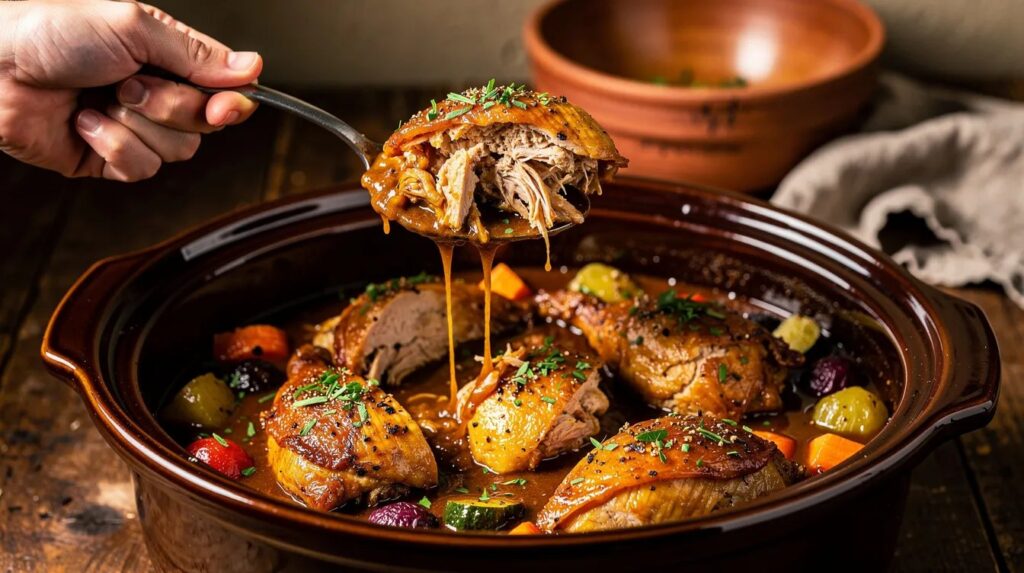
March brings a certain restlessness: with the last cold evenings still upon us, there’s a need for something warm, something that fills the kitchen with an aroma so enticing, the whole household is drawn in without a word. Slow-cooker chicken in a creamy sauce is precisely this kind of dish. Ten minutes of preparation, then the slow cooker takes over, transforming simple ingredients into a comforting meal. It's perfect for this time of year, when we're enjoying lighter days but still want something rich and satisfying on the table in the evenings.
This version achieves its creaminess from a base of gently cooked onions, garlic, and a dash of white wine, finished with double cream and fresh herbs. Tarragon is particularly effective: its aniseed edge cuts through the richness in a way that dried herbs simply cannot. After hours in the sauce, the chicken becomes incredibly tender, falling apart at the touch of a fork and absorbing every layer of flavour. So, put on your apron and get everything ready, as this dish requires very little effort upfront.
| Preparation | 15 min |
| Cooking | 6 hrs (low) or 3 hrs (high) |
| Portions | 4–6 people |
| Difficulty | Easy |
| Cost | ££ |
| Season | Spring onions, fresh tarragon, leeks |
Suitable for: Rich in protein · Gluten-free (check stock label)
Ingredients
- 1.2 kg bone-in, skin-on chicken thighs (approximately 6 pieces), skin removed before cooking
- 2 medium onions, finely sliced
- 4 cloves garlic, crushed
- 2 medium leeks, cleaned and cut into 2 cm rounds
- 200 ml dry white wine (a Sauvignon Blanc or unoaked Chardonnay)
- 300 ml chicken stock (low-sodium, good quality)
- 150 ml double cream
- 1 tbsp Dijon mustard
- 1 tbsp olive oil
- 1 tbsp plain flour (or cornflour for gluten-free)
- 1 small bunch fresh tarragon, leaves picked (or 1 tsp dried, if unavailable)
- 1 small bunch fresh flat-leaf parsley, roughly chopped, to finish
- Salt and white pepper to taste
- 1 tsp lemon juice, to finish
Utensils
- Slow cooker (4.5–6 litre capacity)
- Large frying pan or sauté pan
- Wooden spoon or silicone spatula
- Sharp cook's knife and chopping board
- Measuring jug
- Tongs
- Whisk
Preparation
1. Searing the chicken — the step you must not skip
Remove the skin from each chicken thigh, then pat the pieces thoroughly dry with kitchen paper. This is important: surface moisture will steam in the pan rather than brown, and colour equals flavour. Season both sides generously with salt and white pepper. Heat the olive oil in a large frying pan over a high heat until it shimmers – the pan should be genuinely hot before the meat touches it. Place the thighs skin-side down (now flesh-side down, since the skin has been removed) and leave them undisturbed for 3–4 minutes. The meat will naturally release from the pan when a proper crust has formed; if it sticks, it is not ready. Turn each piece and sear for another 2 minutes on the second side. Aim for a deep, mahogany-brown colour as this is the Maillard reaction, the chemical process between proteins and heat that produces dozens of aromatic compounds. Transfer the seared thighs to the slow cooker insert.
2. Building the aromatic base
In the same frying pan, reduce the heat to medium and add the sliced onions. The residual fat from the chicken adds flavour, so do not wipe the pan. Cook the onions for 6–8 minutes, stirring occasionally, until they soften and become translucent at the edges, starting to turn a pale golden colour. Add the crushed garlic and the leek rounds, stirring everything together for a further 2 minutes until the garlic is fragrant but not coloured, as a burnt garlic base will make the entire dish bitter and cannot be corrected later. Scatter the tablespoon of flour over the vegetables and stir to coat evenly, cooking for another minute to eliminate the raw flour taste. The mixture will look slightly pasty, which is correct.
3. Deglazing and building the sauce
Pour in the white wine in one steady stream. Use the wooden spoon to deglaze, scraping up every dark, sticky bit of caramelised residue from the base of the pan. These dark fragments are intensely flavoured and form the backbone of the sauce. Allow the wine to bubble vigorously for 90 seconds, reducing by roughly a third. Then, pour in the chicken stock, add the Dijon mustard, and stir until everything is combined. Bring the mixture to a brief simmer, then pour it over the chicken thighs in the slow cooker. Tuck in the fresh tarragon sprigs at this stage. The liquid should come roughly two-thirds up the sides of the chicken pieces, as the meat should not be submerged as the slow cooker generates additional steam internally.
4. The slow cook
Fit the lid, switch the slow cooker to low, and cook for 5–6 hours. If you're short on time, the high setting will work for 3 hours. However, the low-and-slow approach gives the collagen in the chicken thighs more time to break down into gelatin, producing a silkier, more unctuous sauce. Avoid lifting the lid during cooking, as each look releases a significant amount of accumulated steam and extends the cooking time by 15–20 minutes.
5. Finishing the sauce with cream
Once the chicken is cooked through and yields easily when pressed - an instant-read thermometer should register at least 75°C at the thickest point - remove the tarragon sprigs and discard them. Carefully lift the chicken pieces out and set them aside on a warm plate, tented loosely with foil. Pour the cooking liquid from the slow cooker into the frying pan over a medium-high heat. Bring it to a steady simmer and reduce for 5–7 minutes until it thickens slightly and the flavour concentrates. Add the double cream in a slow, steady stream, whisking as you pour. Simmer gently for another 3–4 minutes, until the sauce coats the back of a spoon and leaves a clear line when you draw your finger through it. Add the lemon juice, taste, and adjust the seasoning. Return the chicken to the pan, spooning the sauce over each piece.
6. Serving
Transfer to a warm serving dish or bring the pan straight to the table. Scatter the chopped flat-leaf parsley over the top just before serving: it adds a fresh, green note that immediately lifts the richness of the sauce. Serve alongside steamed new potatoes (just coming into season in the UK by late spring), crusty bread, or buttered egg noodles, whichever suits your table.
My chef's tip
Bone-in thighs are essential here: the bone releases collagen as it cooks, thickening and enriching the sauce in a way boneless pieces simply cannot. If you can only find boneless thighs, reduce the cooking time by 30–45 minutes and add an extra splash of stock to compensate. At this time of year, when the first bunches of fresh tarragon appear at market stalls, use it generously. Its flavour is at its brightest in spring and it has a natural affinity with cream and poultry that dried tarragon cannot match. Pour yourself a small glass of the same white wine you cook with at the deglazing stage – it's well worth it.
Wine pairing
The sauce is creamy and herb-forward, with a gentle acidity from the mustard and lemon, so a white wine with enough body to hold its ground without overpowering the delicate tarragon is needed.
A white Burgundy - particularly a village-level Mâcon-Villages or a Saint-Véran - works well, bringing notes of ripe apple, a hint of butter, and enough mineral tension to cut through the cream. A good-value alternative is an unoaked Chardonnay from Chile or South Africa, widely available in UK supermarkets and more than capable alongside this dish. For a non-alcoholic option, a sparkling elderflower and apple pressé provides the same contrast of sweetness and gentle acidity.
About slow-cooker chicken
The slow cooker, sometimes known as a "Crock-Pot" (a brand name that became the generic term in much of the English-speaking world), became a staple in the domestic kitchen during the 1970s, when long working hours made hands-off cooking genuinely practical. Creamy chicken dishes have a longer history however: the French poulet à la crème from the Bresse region of Burgundy is one of the most celebrated, based on the same principles of slow heat, good stock, and generous cream, and served with the same respect as a roast in Britain.
This slow cooker adaptation removes the need for constant attention without losing the depth that braising creates. Over the years, it has become a reliable part of British family cooking, alongside shepherd's pie and roast dinners, as something that can be started before school or work and be ready by the time everyone is home and hungry. The addition of leeks and tarragon gives this version a quietly French feel while remaining accessible. Versions exist across the world: in Hungary, paprika and soured cream replace the tarragon and double cream, while in the American South, cream of mushroom soup replaces the stock-and-cream base – simpler, less nuanced, but equally loved.
Nutritional values (per portion, approximate values)
| Nutrient | Amount |
|---|---|
| Calories | ~420 kcal |
| Protein | ~38 g |
| Carbohydrates | ~9 g |
| of which sugars | ~4 g |
| Fat | ~25 g |
| of which saturates | ~12 g |
| Fibre | ~2 g |
Frequently asked questions
Can this be prepared ahead of time?
Yes, it often tastes better the next day, once the flavours have settled and deepened overnight. Complete the recipe up to the cream stage, allow it to cool fully, then refrigerate it covered for up to two days. Reheat gently on the hob over a low heat, adding a splash of stock or water if the sauce has thickened too much during refrigeration. Avoid boiling during reheating, as prolonged high heat can cause the cream sauce to split.
How should leftovers be stored?
Cool the dish to room temperature within two hours of cooking, then transfer it to a lidded airtight container and refrigerate for up to three days. The chicken can also be frozen: portion it into freezer bags or containers before freezing for up to three months. Thaw fully overnight in the refrigerator before reheating. Cream-based sauces can occasionally separate on reheating from frozen, but a brief whisk over gentle heat usually brings them back together.
What substitutions or seasonal variations are possible?
In early spring, leeks can be replaced with the first young spring onions, added in the final 30 minutes rather than from the start to preserve their texture. In summer, a handful of halved cherry tomatoes and fresh basil transforms the dish into something brighter and more Mediterranean: reduce the cream to 75 ml and add the tomatoes for the last hour only. Crème fraîche can be used instead of double cream for a slightly tangier, less rich result. Replace the wine with an equal quantity of additional stock plus one teaspoon of white wine vinegar to replicate the acidity for those avoiding alcohol.
Can chicken breasts be used instead of thighs?
Thighs are strongly recommended for slow-cooker cooking because their higher fat and collagen content keeps them moist over a long cooking period. Chicken breasts are leaner and can dry out and become stringy when cooked for several hours. If using breasts, switch to the high setting and reduce cooking time to no more than 2.5 hours, checking for doneness at the 2-hour mark. The sauce will be slightly less rich, but the dish remains worth making.
Is this recipe suitable for children?
This recipe is well-suited to family cooking with its mild sauce and familiar flavours. When cooking for young children, replace the white wine with an equal measure of extra stock; while the alcohol cooks off during deglazing, some families prefer to omit it entirely when small children are eating. The Dijon mustard adds warmth rather than heat but reduce it to half a teaspoon if your household is sensitive to it.